I suppose everyone has seen this video by now.
I’ll start off by saying that from a big picture point of view, I don’t know much about this incident. I don’t know much about Occupy Wall Street, I don’t know what (if any) goals they have. I don’t know what these students were trying to accomplish, or whether they knew what they were trying to accomplish, or how legal their protest was. I also don’t know much about the overall decisions from the cops’ point of view. Whether it was necessary to move the protestors or not, whether it was necessary to intervene at all, I can’t say. My issue with this is from a much more technical point of view. That’s not how you run a revolution, and it’s not how you deal with one. Both sides seemed amateurish to me.
First, from the cops point of view: Let’s bypass the question of the legality of breaking up the protest, and the decision to make the arrests and skip straight to how that decision was executed. Cops on UC Davis campus: automatically in hostile territory. They can start by knowing that 1: they are not welcome; 2: they are already assumed guilty until proven innocent; 3: they are surrounded by cameras, which is essentially a hostile PR campaign already under weigh. Thanks to this attitude, combined with the ubiquity of I-Phones and youtube, police ought to know that even before they get on the ground they are already the target of choice for a decentralized mechanism of propaganda gathering and distribution.
This situation is the truth on the ground. Lack of situational awareness of this strategic concern is the root issue behind the mistakes made.
If you watch the video carefully you’ll notice that the only voices you can hear are the voices of protesters. They are not especially unified, not especially controlled, but they have one advantage: they are loud. By contrast the cops are absolutely silent. They aren’t yelling and screaming, only a few of them are doing the talking and they appear to be the command and control (C&C) element for the riot control unit. This is good unit discipline, but bad PR. It means that the only point of view that is going to be heard is the protesters. Anything the cops say afterwards is automatically damage control at best, which leads me to my first critique: where was the megaphone? If you are a riot control unit, your megaphone is your primary weapon. If you don’t have one, you’re wrong. You can’t shout down the protestors, but you can at the least make sure that you are providing a step by step narration of what you are doing, which is then an intrinsic part of any audio record of the event.
Next step, the decision to arrest was made. Already their actions are crippled because they don’t have the shouting power to issue clear instructions or ultimatums. All we see is one muttered contact in the first ten seconds, and then two minutes of the cops standing around, silent and indecisive. I know what they are doing. They are pulling security, while the C&C element makes up their minds what to do. Bravo on maintaining good discipline, but in the long run it makes them look like idiots. At 2:12 you can see one officer make one half-hearted attempt to pull one of the protesters out of their formation. Everyone knows what’s coming, but the cops are not visibly trying to resolve the situation without escalating to the use of chemicals. So I have to ask, what is their protocol? Given a decision to arrest, it might be argued that it’s safer to break up the formation with pepper spray than with batons. I would whole heartedly agree with that. However, there has to be an escalation of force protocol. Warnings (mostly inaudible apparently) notwithstanding, I would question the wisdom of going directly from verbal warning to pepper spray. There has to be an intermediate level of force.
Starting at 2:05 you can hear a female voice yelling “Protect yourselves, cover your eyes.” Why shouldn’t that warning have come from the cops? Nothing enhances your image like visibly and obviously seeking to limit damage to your opponents.
The actual spraying, from 2:25 on is obviously visually disturbing to civilians. It looks so wanton, so cold-blooded, so cruel. He’s spraying it right in their faces and they aren’t violent, aren’t visibly resisting. It screams “Police Brutality.” From a tactical point of view I can understand it, though. Once the decision is made to move them, and the tool chosen is pepper spray, it makes no sense to delay or be half-hearted about it. Either do it or don’t do it, but don’t half do it. It does no one any favors to draw it out. One quick pass across their faces is not going to damage them seriously, and from then on out, it’s all business. Break up the formation, pair up on the protestors, cuff them and move them out. I would have had my paddy wagon closer, but other than that it was tactically pretty good. They don’t lose security either. The perimeter gets pretty thin at one point, but by 4:30 all the moving pieces are resolved. The perimeter is full and solid, and it needs to be. They are surrounded by a crowd, and maybe the crowd was initially spectators, but now they are clearly shifting into protester mode. Anyone who was not involved before is involved now. A solid perimeter is a must.
Say what you will, from the point of view of the cops it is a tactical success. They moved into a hostile crowd, arrested the focal point of that crowd and moved out in less than ten minutes with no injuries on either side. No one broke ranks, no one went crazy, the objective was met and the withdrawal was planned and disciplined. The problem is, no one is ever going to see it from their point of view except those who already know it.
Now, let’s move to the protestor side of the house: Overall I am left with an impression of simple, mass hysteria. They did a lot of things right. There were clearly movers and shakers within the crowd who were periodically able to start a mass chant, aided by the fact that it’s friendly territory for them. Those most involved have at least passive support of everyone around them, and moral support from a majority of potential youtube viewers. They can move with ease, their risk is minimal due to the cops’ rules of engagement, and their payoff is potentially high. The big questions I have really come down to, What’s it all about? Who organized the protest? Who decided to occupy that particular piece of ground, and why? Was pepper spray anticipated? Apparently not, but an intelligent organizer might have anticipated it, and planned a ready-made PR campaign for it. Overall, though, my impression is of hot-headed, young, amateurish disorganization. I would bet most of the people there could not have told you why they were protesting or what their goals were in any coherent form that would hold water for more than a minute. They didn’t need to. Whoever organized it doesn’t need intelligent disciples to provide rational argument on a popular level. He needs bodies to fill space, and vocal cords to fill the air with noise.
The exploitation of the incident was ad hoc, and hot-headed. At 8:56 you can see that the crowd is getting riled up, and is starting to press the cop’s withdrawal. A cop flashes a tear gas canister and a student yells “They’re spraying again.” The crowd backs off a little and at 9:05 you hear a voice start rising out of the chaos. Again, it is not the cops, it is a protestor. He essentially leads the crowd in proclaiming that they are going to give them a moment of peace so that the cops can leave. By 9:33 they are cheering and shouting as if they drove out the invader, when that is simply not what happened. It was a spur of the moment thing, and it was hot-headed. Taunting edgy, adrenalized cops in a situation like that is far from a smart move, tactically. Strategically it makes all the sense in the world because any reaction on their part is more fuel for your fire later on, but the fact remains that it was only the fact that those police officers were disciplined and did not rise to the taunts that saved those kids from a serious hurting. Their restraint was the protestors’ only guarantee of safety. The taunting was a juvenile attempt to appear in control of the situation, when that was far from the truth, but once again, the truth matters very little to America. The cops won the battle, but they lost the war.
The protestors were a little lacking in follow-up, though. This is a golden opportunity to get the message out but there seems to be an issue: There is no message. There are only pity-parties, such as this first class example of incident exploitation. No manifestos. No pithy statements of objectives. There aren’t even any demands. I still have no idea what they were protesting. There should be a website with clearly defined problems to be addressed and solutions to those problems proposed. But I haven’t seen it. Nothing.
This leads me to my biggest issue with the protestors. In the Army we have a saying: “If you don’t have a solution, don’t point out the problem.” Apparently these kids see a problem. Whether it is a legitimate problem or not I don’t know, but all they are doing is criticizing. As far as I can tell there is no effort to come up with a solution. That’s the government’s job, apparently. There is no coordination, no planning, no foresight. They seem to be flying on the seat of their pants, letting an agenda emerge haphazardly as they go along. As someone with some degree of specialized knowledge on this subject, that’s no way to run a revolution, unless your goal is simply mass hysteria. I can think of several scenarios that would fit that picture.
I do not take sides on this issue. I neither condone the use of tear gas, nor do I agree with the protestor’s allegations of police misconduct. If I have put a little more time into showing what I perceive to be the cops’ point of view it is because no one else seems to. I am trying to avoid Monday morning quarterbacking. Instead I am trying to provide an honest and objective assessment of both sides. I have no illusions that either side will read it, but it might just help a few spectators find a more balanced and hopefully charitable view.

Saturday, November 26, 2011


Monday, November 21, 2011
Comfort Camping
My weekend in the woods was excellent. It rained cats and dogs the first day, and part of the first night. After that it cleared and after the first two nights it warmed up as well. I am not used to using a tent in the field, so I was a little surprised at how much of a difference it makes, but I think I’m probably going to invest in a hammock with a rain screen for my future comfort camping trips.
I feel like St. Paul, knowing how to get by with a lot or a little. I’ve slept in a torrential downpour with nothing but the clothes on my back, and I’ve slept in big tents, little tents, cabins, apartments, houses, guest rooms, hotels, airplanes, Humvee seats, and even cars.
We also had a few patients, myself and the other medics: sprains, strains, muscle and joint aches, and even a stick in the eye and FOOSH (Fall Over Outstretched Hand). A lot of ibuprophen, ice, ace wraps etc. A couple of ER transfers for x-rays. Nothing too spectacular. And of course, there are the feet. The never ending cycle of dirty feet after every event with blisters to be trimmed and dressed, nails to be cut, advice to be given, an occasional lecture about proper foot care. Really, if you maintain your feet properly you should never need to see a medic for them. I never have, although I have been gifted with very hard feet. On the other hand, I like doing foot care. It may sound strange, but I do. I like all aspects of patient care, but there is something about feet, hands and eyes that really appeals to me. I marvel at the amazing coolness of these structures. I also learned that I’m never going out to do med coverage again without my iris scissors. Trauma shears are just not the right tool for trimming blisters. As a matter of fact, once I get my whole minor surgical kit assembled, it is going to be my constant companion.
This is me and one of the other medics out in the field, chilling out. Someone got this with a cell phone while I was doing my morning bible reading and making oatmeal. Notice the product placement I am doing. SF soldiers use domino sugar.

I feel like St. Paul, knowing how to get by with a lot or a little. I’ve slept in a torrential downpour with nothing but the clothes on my back, and I’ve slept in big tents, little tents, cabins, apartments, houses, guest rooms, hotels, airplanes, Humvee seats, and even cars.
The main difference between tactical camping and comfort camping is how quickly you can pack up. With tactical camping you have to be ready to go in an instant, which means that you don’t unpack anything you don’t absolutely need, you don’t bring anything you don’t absolutely need, and you go where you have to, when you have to. With comfort camping you can take your time picking up and moving, so you can spread out a bit. You can pitch a tent, start a fire (no need to worry about it giving away your position. You can sit around that fire and chat with the guys, or read a book. It is a remnant of my tactical habits that I don’t like to go camping with more than I can put in one rucksack and walk out with. I guess what I like doing is backpacking. On this trip, though, I brought my 44 Kg kettlebell. I can throw it up on top of the ruck and walk the whole thing out if I need to, although it would be slow. However, I needed to keep up some kind of workout routine while I was out there. As it turned out I had time to use it more than once, and time to go on a couple of runs.
Most of the time we just sat around and read books or talked. I finished Dubay’s “Evidential Power of Beauty,” and Nelson Mandela’s Autobiography, as well as both of the Little House on the Prairie books I brought, and started “The Brothers Karamazov.” That’s going to be quite a while to get through. It’s 900 pages long, and it took me hours of steady work just to get through the first 100 pages or so. I usually average 80-100 pages an hour. Russians! But it is good. I am enjoying it slowly.
I also started “The Image of Beatrice” by Charles Williams, a contemporary of C.S.Lewis and J.R.R. Tolkein. I’ve read two of his novels (“Descent into Hell” was easily the most understandable and terrifying portrayal of hell I’ve ever read.) I’ve also read his “Outlines of Romantic Theology” which was both beautiful and demandingly coherent. I am somewhat ashamed to admit that I’ve never read more of Dante than “Inferno” and from reading Williams I am inclined to believe I have never really even read that much. Thus far I am especially impressed by his blending of supernatural, mystical and even romantic awareness, with rigorous, clear sighted realism. He does what I aspire to do, seeing and knowing the world with every faculty of his being, heart and mind, body and soul. His distinction between the way of rejection and the way of affirmation as opposite but complementary aspects of the Christian life is also a brave thought. It was kind of an en-passant thing thus far, but it rises from his holistic awareness of creation. It is a concretization of ideas I’ve been working through recently, but too much to go into at the end of a casual blog post.
Man, books are just not as much fun without someone to talk them over with. The trouble is, no one around here reads the same books I do. You miss something when a book doesn’t go through you. People are like rivers. We are meant to take in good things but not to hold on to them. If they don’t move through us and flow on in blessings to other people they stagnate and die. Fortunately there are many, many ways for blessings to flow on.
We also had a few patients, myself and the other medics: sprains, strains, muscle and joint aches, and even a stick in the eye and FOOSH (Fall Over Outstretched Hand). A lot of ibuprophen, ice, ace wraps etc. A couple of ER transfers for x-rays. Nothing too spectacular. And of course, there are the feet. The never ending cycle of dirty feet after every event with blisters to be trimmed and dressed, nails to be cut, advice to be given, an occasional lecture about proper foot care. Really, if you maintain your feet properly you should never need to see a medic for them. I never have, although I have been gifted with very hard feet. On the other hand, I like doing foot care. It may sound strange, but I do. I like all aspects of patient care, but there is something about feet, hands and eyes that really appeals to me. I marvel at the amazing coolness of these structures. I also learned that I’m never going out to do med coverage again without my iris scissors. Trauma shears are just not the right tool for trimming blisters. As a matter of fact, once I get my whole minor surgical kit assembled, it is going to be my constant companion.
This is me and one of the other medics out in the field, chilling out. Someone got this with a cell phone while I was doing my morning bible reading and making oatmeal. Notice the product placement I am doing. SF soldiers use domino sugar.

Should I get paid for that?
Wednesday, November 16, 2011
Camping Trip
This is what you get for volunteering:
The newest students in the course are getting ready to go out for land nav practice and testing, (that’s the thing where you try to find your way around the woods with nothing but a map, a compass, a totally useless rubber rifle and an equally useless and much heavier rucksack.) The cadre running it have asked the graduating class for a few medics to do med support for this event. There were three medics signed up, but two couldn’t make it out for some reason, so in formation yesterday the cadre said, “Hey, we have a land nav thing for the junior class on Thursday and I need two more volunteers for med support.”
Crickets… Crickets... All the brand new medics are staring off into the wild blue yonder, pretending we can’t hear.
“Come on, give me two. I need two hands.”
Dum-de-dum-de-dum, I’m just standing here trying to be invisible. Don’t mind me.
“Let’s go, medics, I’ve got all day.”
Okay, this is looking a little embarrassing. It’s just med support, so you go out there on Thursday and sit around hoping no one hurts himself. No big deal. Somebody has to, so I decided it may as well be me. I raised my hand.
“Okay, go link up with the --- guys to figure out where and when you need to be.”
So accordingly I went and linked up with them. It turns out this little exercise does indeed start Thursday, but it continues Friday, Saturday, Sunday, Monday, Tuesday and possibly Wednesday as well, depending on how bad these guys are at land nav. Nice.
Oh well, there it is. What can you do? Well, since this is not tactical camping for me, this is going to be comfort camping. I’m bringing all sorts of little comfort items out with me, this time, and I’m going to be straight chillin’. I’m bringing books, snacks, a pot, a cup, oatmeal, sugar and tea, and even a tent in case of weather inclemency! This is going to be the most laid-back camping trip ever.
Did I mention I’m bringing books? “The Evidential Power of Beauty,” by Fr. Thomas Dubay; Nelson Mandela’s Autobiography, “A long walk to freedom”; The Brothers Karamazov; Little House in the Big Woods, and Farmer boy, and of course, my trusty Bible. I’m set. See y’all when I get back.
The newest students in the course are getting ready to go out for land nav practice and testing, (that’s the thing where you try to find your way around the woods with nothing but a map, a compass, a totally useless rubber rifle and an equally useless and much heavier rucksack.) The cadre running it have asked the graduating class for a few medics to do med support for this event. There were three medics signed up, but two couldn’t make it out for some reason, so in formation yesterday the cadre said, “Hey, we have a land nav thing for the junior class on Thursday and I need two more volunteers for med support.”
Crickets… Crickets... All the brand new medics are staring off into the wild blue yonder, pretending we can’t hear.
“Come on, give me two. I need two hands.”
Dum-de-dum-de-dum, I’m just standing here trying to be invisible. Don’t mind me.
“Let’s go, medics, I’ve got all day.”
Okay, this is looking a little embarrassing. It’s just med support, so you go out there on Thursday and sit around hoping no one hurts himself. No big deal. Somebody has to, so I decided it may as well be me. I raised my hand.
“Okay, go link up with the --- guys to figure out where and when you need to be.”
So accordingly I went and linked up with them. It turns out this little exercise does indeed start Thursday, but it continues Friday, Saturday, Sunday, Monday, Tuesday and possibly Wednesday as well, depending on how bad these guys are at land nav. Nice.
Oh well, there it is. What can you do? Well, since this is not tactical camping for me, this is going to be comfort camping. I’m bringing all sorts of little comfort items out with me, this time, and I’m going to be straight chillin’. I’m bringing books, snacks, a pot, a cup, oatmeal, sugar and tea, and even a tent in case of weather inclemency! This is going to be the most laid-back camping trip ever.
Did I mention I’m bringing books? “The Evidential Power of Beauty,” by Fr. Thomas Dubay; Nelson Mandela’s Autobiography, “A long walk to freedom”; The Brothers Karamazov; Little House in the Big Woods, and Farmer boy, and of course, my trusty Bible. I’m set. See y’all when I get back.
Sunday, November 13, 2011
Green Hat

It would be years before I finally got the chance to go to selection, and I didn't make it the first time. I smoked all the physical and mental tests, but my interpersonal skills were not up to par. At the end of Selection I was non-selected as "too much of a loner."
I didn't want to go back. It was a hard school, and I felt like a redo was just too much work. So I spent four more years in the regular army, working my way up from specialist to sergeant, to staff sergeant, and gaining experience as a soldier and as a leader. After fifteen months in Afghanistan, during which I served as a squad leader in combat for more than a year, I felt readier and went to selection again with a very clear plan in my head: I would either make it and go Special Forces, or I would finish my enlistment and get out. At the time I was strongly thinking of entering the seminary if SF didn't work out for me.
The second time through was ten times worse than the first time. They had shortened it from 24 days to 14 days, but still had all the same events, and some of them were even harder than I remembered. The shortened timeline meant very little sleep, no time for food, and a much more distant and stoic cadre. When I finished, still standing tall at the end, I knew it was only the grace of God that had gotten me through. Once you are selected that certificate is good for two years. You don't have to decide to go to the Qualification course right away. I had planned on taking some time off, not making my decision right away, but taking some time to think and pray about whether SF was really what I wanted to do, but when I sat down with the Cadre who was counselling me on my selection at the end, something else happened. He said, "Congratulations you have been selected. Do you want to accept your selection right now?" I opened my mouth and the words, "Yep, and I want to be a medic," came tumbling out of my mouth. It was not my plan, but as soon as I said it I felt like it was a pretty good plan after all. I had already been a regular army engineer for six years. Why not do something different. The Cadre was surprised, but he signed me up for it. I also got my first choice of language, which was Korean.
Fast forward almost three years, through Airborne School, leadership training, Korean School, Small Unit Tactics, SERE school, the year long Medic School, culminating last month with the famous "Robin Sage" exercise.


This is me shaking hands with my Dad.
It has been a long road, and it ain't over yet. It's just begun. I now have a three year commitment to an operational Special Forces group, with many deployments around the world ahead of me. I have a commitment to furthering my medical knowledge and skill level, possibly becoming an MD eventually. Add to all of this that I have a deep certainty that Special Forces is not my ultimate calling. God is calling me to something else, and SF is just a step on that road. I don't know what it is, yet, but I think it will be cool.
He is faithful. HE has gotten me this far. I have no fear.
Saturday, November 5, 2011
Ruck
“Tramp!” goes the boot as it crushes the ground,
“Stomp!” goes the heel, and “Slap” goes the toe.
The rucksack creaks and squeaks, the ponderous sounds
Of overloaded canvas, in time with the slow,
Slow, agonizing pace of too many pounds
At least a hundred, sagging from my spine.
I feel it in my shoulders, I feel it in my feet
Slapping down and down and yet again down,
Always slapping down.
With shockwaves like a hammer on hamburger meat
Plodding on clay, on shale, on grass, weed and bush
Trudging in the dust of the field or echoing on the street.
Pain from toe to heel, pain from heel to knee and then
Shooting up in grinding vibrations to hips and lumbar spine
As every one of these weary, dogged men
Stoop and limp and plod under the weight of the ruck;
That damned unwieldy tick that we’ve strapped on again;
To carry across the land.
Through the night, through the rain,
Through the draws and hills and swamps and thorn;
Pitch black sticks in the pitch black night
That stab you in the eye with careless scorn.
The “wait-a-minute” vines that claw and clutch and drag
And lie in wait for our heels, in the dark before the morn,
As we curse our way onwards in pitch black
Sans moon and stars, and wish we were never born,
Or if born, at least born normal people, not the sort
Who volunteer for this tomfoolery!
But that awful ruck!
All else is really an afterthought, my mind always returns
To that creaking, sagging, soul crushing bundle of suck
Ninety pounds of gear on my back: ammo, water, food
Clothes, med bag, and explosives just for luck;
Then, to top it off a 25lb necklace! The iron pig,
Swinging in front of me by its sling.
80 clinking rounds in the feed tray, to start with,
“Carry as much ammo as you can bring.”
And then a bandoleer of 120 more, because hey, you never know!
Muzzle and bipod stick out like a broken wing,
Catching the brush and shifting, sliding canvas on my collar,
After a few hours that will start to sting.
But someone has to carry it, right?
It’s really just the weight.
I carry it, not on my spine, but on my soul like a brick.
My spirits sink as hour after painful hour drags on,
And from twenty-two to zero-two we’ve moved barely a klick
And left half our mojo behind, somewhere in the draw.
The wait-a-minute vines got it. The bush was just too thick.
We hit the tracks and make up some time,
Urging speed from battered limbs and trying our best
Not to twist our ankles between the ties,
Or in the gravel. Pushing on. Only a minute for a rest.
Behind schedule. Forget security, out on the road,
And run. We need to make link-up, so haul butt
With dogged, shuffling, comical steps under the load,
For half a mile of open blacktop,
Ready to dive into the brush if a glimmer showed.
Of headlight, but nothing comes. Civilized people
Are all asleep right now. We run
Praying there’s a ride at the end of this one.
But no.
Alas, only an angry, nervous face,
And a stream, and a quick, “Follow us.”
Then lights running off into the darkness.
“Awww. Sad face.” Someone says, but no more fuss.
These guys are running light, and they know the way,
And they’re fresh. We barely have breath to cuss
And we have a guy with a sprained ankle.
Little things like that, you know, they add up.
Who’d have thought?
The lights go on, and on, and on
Up the ravine. We fall behind, get separated.
Link back up, move out again, fall behind
And half our element moves on without us.
If it weren’t for the injured guy I wouldn’t mind.
I swear I’d still smoke half of them even now.
But this guy can barely limp, and I can’t find
The slightest glimmer of light ahead, just black.
“Crossload his gear.” Everyone gets something.
They wait for us, we link up again, move back out.
Farther and farther, up and down, on and on.
This is not much fun, I think, with a slight pout.
No one can see my face, so I’ll pout if I like,
I just want to be rid, once and for all, of this
Terrible,
Hideous,
Malignant,
Sneering
Hateful
Ruck!
But here we are.
Forming a perimeter, facing out, catching a breath
A quick meeting in the center and the word comes out,
“We’re stopping here tonight. Rucksack flop.”
Tonight, indeed? All two hours of it before it’s light?
But at least we can stop,
Face inward,
Crouch down,
And let the ruck do the work:
Sag,
Sway,
Pull,
Fall over backwards
And rest on the ground, leaning against that beast
Like a lazyboy recliner, as all the stress
And tension drift away and are released.
Every muscle and sinew are totally relaxed,
And light and warmth and pure endorphin high
Flood every corner of my being in a rushing flow
Of pure, unbridled bliss.
A bliss which, without the rucksack, I would never know.
Wednesday, October 5, 2011
Punching Bag Woes
So this is a complaining post. I’m complaining about the fact that there are no good punching bags in any of the gyms I’ve been in on Fort Bragg, and I’ve been in most of them.
I’m serious, this is an issue to me.
 You would think, on a military installation a punching bag, in fact, multiple punching bags, would be standard equipment. They had one hanging up in the student gym at the medic school, but it was pretty worthless. It was one of the kind that hangs up on the metal frame with the two support pipes running to the floor on either side of it. Perfect for breaking your foot on if you do a round house kick just a little off target. It needed to be weighed down with several hundred pounds worth of weight plates just to keep it flying across the floor. But it was better than nothing. Then the cadre got angry at us for denting the floor by dropping weights on it so the closed the gym to students and it became the cadre gym.
So then I brought my own personal punching bag in and hung it up in the quad by the barracks. It was a perfect set up. Alas, there was a small cut on one surface of the bag, and with too many people abusing it and not using it properly and constant exposure to the elements, it ripped open. I took it down planning on repairing it, but the Sergeant Major had it thrown away because it was an “eye-sore”. My punching bag! The one that I paid good money for.
A gym just across the street came to my rescue, though, They opened up a boxing room and a grappling room. The grappling room is a 20’ x 20’padded room with good quality matts, and the boxing room had six short bags and two long bags hanging from two stands. As soon as I saw the stands, I knew they wouldn’t last long. Each stand consisted of a single steel post going straight up into the air and branching into a four sided frame. It stood on a 12” x 12” metal plate, held in place by four bolts into the concrete. The leverage was so obviously too great for the bolts that I couldn’t believe anyone had seriously paid money for it. Some fat civilian contractor who has never thrown a punch in his (or her) life probably okayed that purchase. At any rate I used the heck out of it for about a month and a half before the kicking accumulated, and then came the one kick so hard that the bolts ripped clean out of the concrete. After that the gym took down the bag stands and has not responded to any of my inquiries about when they will replace them. The people at the desk tell me I should, “Take it up with the committee.” Something about budgeting. Please! They have the bags. I’ll go down to Lowes and pick up all the stuff I need to hang them so that they will never break, and it would cost me about fifty bucks.
 I bought another punching bag and hung it up again in the quad, and I did a lot of good training on it. Then somebody took it down while I was on clinical rotation, and I have no idea what happened to it. Probably another “barracks cleanup”. How by any stretch of the imagination does a punching bag constitute a non-military appearance? A barracks without a decent punching bag is the disgrace, in my opinion.
The gym tried to set up a punching bag stand with a water filled base, but I kicked the top off of it with my third kick. It was a lousy design.
Now they have fallen back on the muscle guy dummies. These are not as good as a bag for hitting because of two flaws. The rubber they are made out of is too soft, and if you hit them too hard they fall over and you have to pick them back up again. Still, better than nothing.
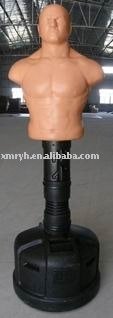
So yesterday I threw 800 punches on one of those dummies. My left hand is a little bloodied. The space between the knuckles of my pointer and middle fingers blistered and ripped, and I got a small rip on the knuckle of my pinky. That’s the problem with punching rubber, it creates more friction, and my left hand wasn’t ready for it, but my right hand is still like a rock.
I sometimes say that the perfect fitness program requires very little equipment. At a minimum you need something to lift, something to hang from, and something to hit. Of those three, hitting things is possibly the most satisfying. There is just something about a solid, perfectly placed punch that pleases me. Deep down inside I enjoy it. When every muscle and bone in my body works together as a single unit, all contracting, twisting, tightening and cracking like a whip, in perfect cooperation as fast as you could blink, and the whole force and weight of my 210 lbs smacks into the leather focused behind the point of a single knuckle, it’s just satisfying. It really is. You have to experience it to understand it.
But it is important to me, both as an esoteric exercise and as a practical skill. I firmly believe that every man needs to know how to throw a proper punch at a bare minimum. How much more every soldier? Can you, then, explain to me why a punching bag is not a standard fixture in every barracks in the army?
I can’t.
Monday, October 3, 2011
Patients are More Fun when they Aren't Drama Queens
One evening a little girl came into the ER. She was about nine years old, and she had fallen on her outstretched hand while roller-blading. Her right arm was in a sling and she had abrasions on both her knees, but what really struck me when I walked in the room was the fact that she was sitting contentedly and quietly on the edge of the gurney, kicking her legs and looking around with interest. She was little and cute in the way that only little girls are, with messy brown hair done up in a sort of pigtail. She was still wearing shorts and a t-shirt, although someone had thrown a man’s zipper jacket over her shoulders, because the room was cold. Her parents were standing on either side of her, looking anxious, but she had a bright, intent, wide awake look. Her eyes were open all the way and a little extra as if she was perpetually amazed that there was so much in the world to see. She grinned at me as I walked into the room in my scrubs with my beard and that reminded me just how awesome my job was.
“Hello,” I said cheerfully. “What brings you in here tonight?”
“Oh,” she said casually, as if it had just suddenly occurred to her, “I fell while I was roller blading.” Her voice was cute too, very high pitched and squeaky. She said it with a perky attitude like, “Oh, if you must know. It’s probably not even worth mentioning, but you asked.”
I knelt down in front of her and examined her knees very carefully. “Hmmm, yes, I see. Wow. Well, you know, I think we can take care of this. I can call a surgeon and well get you scheduled in. We’ll probably take them off right about here.” I made a slashing motion across her legs right above her knees.
She laughed and squealed, “No!”
“What? You don’t want us to take off your legs? Really? Then why are you here?”
“This!” she laughed and held out her arm in the sling.
“Ohhhhhhhhhh!” I nodded, because it was all so clear now. “So that’s why your arm is in a sling. Oh, I get it. Okay, so what happened to that?”
“I fell on it,” she giggled.
I got her to describe how she had landed, and to point out exactly where it hurt, but she assured me that it didn’t hurt very much at all. I made her go through all her ranges of movement with her wrist and elbow, and then poked and prodded and pinched and squeezed. “Does it hurt here?”
“Nope.”
“Does it hurt here?”
“Nope.”
“Does it hurt here?”
“Nope.”
“How about here?”
“Not really.”
“You know what? I’m not even going to ask you any more questions, because you’re too tough. You could probably be lying on the floor with your hand cut off and I’d ask, ‘Does it hurt’ and you’d say, “No, not really’.” I said the last part in a high, squeaky voice to illustrate how she would say it.
She just laughed at me. Her parents relaxed a little bit when I explained to them that she might have a small fracture but it didn’t look serious and we’d get some x-rays to see exactly what was going on.
For an adult I wouldn’t even have needed an x-ray, although in a civilian hospital I probably would have gotten one just because it’s expected. Since she was a child, though, I wanted to make sure there was no crack in the growth plate. In the ends of every bone in a child’s body is a thin plate of cartilage sandwiched between the end (epiphysis) and shaft (diaphysis). The area where it attaches is called the metaphysis. As the child grows the cartilage grows and gets longer and longer, while at the same time it is being replaced by bone which does not grow. At some point, usually in the teen years, the bone replacement catches up with the cartilage growth and then that limb stops growing. When this happens in all bones of the body the person has reached his or her full height. However, if the plate is damaged while the child is still growing this can cause the growth to be lopsided or deformed or even to stop altogether. Hence the reason I ordered an x-ray.
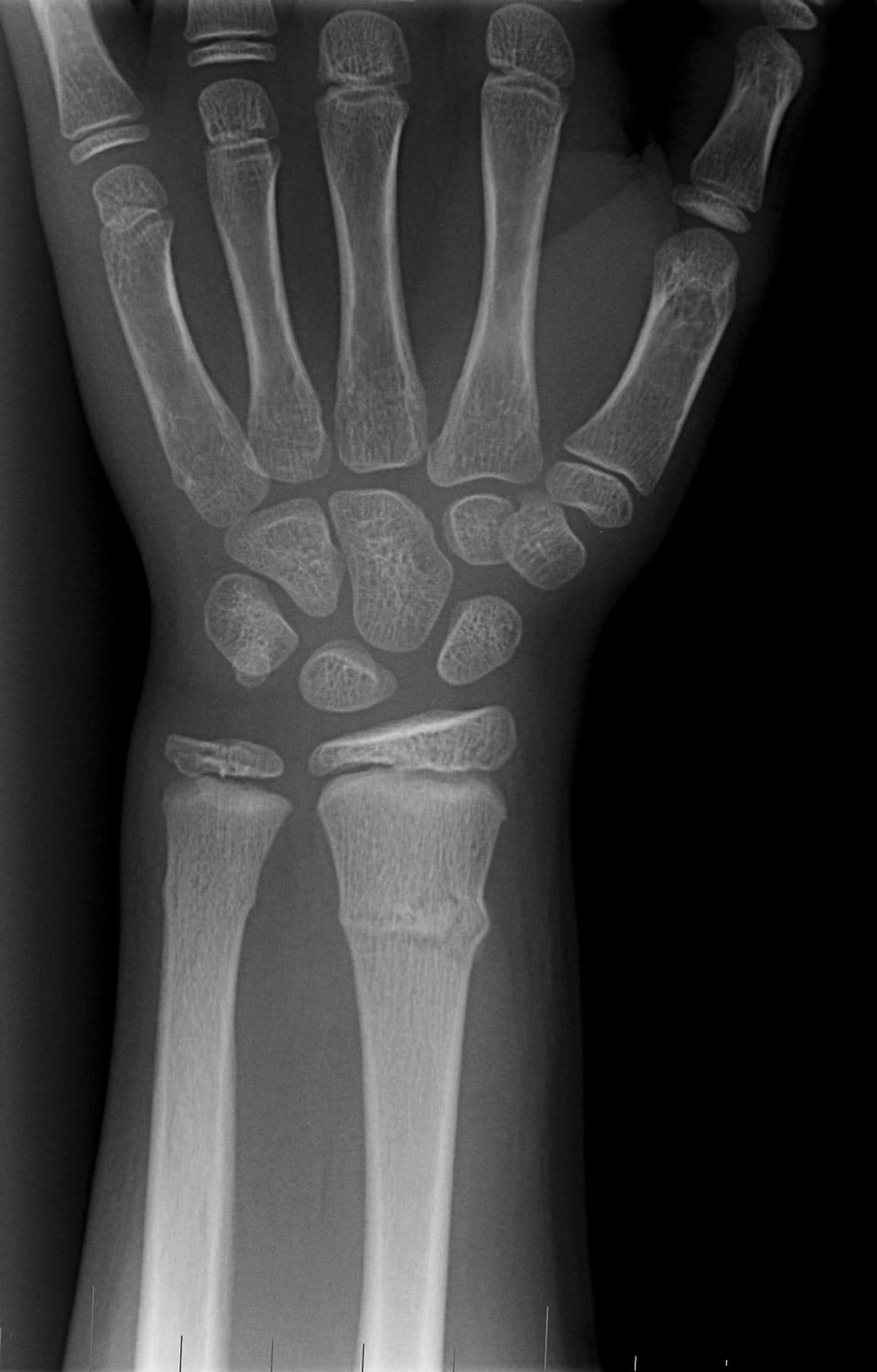 As it turned out her growth plates were fine. The only damage was a torus fracture of the radius and ulna. Another characteristic of children’s bones is that they are softer and more flexible than an adult’s bones. Under stress they tend to bend and wrinkle rather than crack, somewhat analogous to the difference between a green twig and a dry stick. A torus fracture (also known as a buckle fracture) occurs when the outer layer of the bone, the cortex, wrinkles under pressure. It's pretty easy to see in this example from medscape. Follow the long bones up towards the wrist and you will see a buckle in each side of the bone. Hers looked very similar. She thought it was pretty cool that she could see it on the x-ray.
“Hello,” I said cheerfully. “What brings you in here tonight?”
“Oh,” she said casually, as if it had just suddenly occurred to her, “I fell while I was roller blading.” Her voice was cute too, very high pitched and squeaky. She said it with a perky attitude like, “Oh, if you must know. It’s probably not even worth mentioning, but you asked.”
I knelt down in front of her and examined her knees very carefully. “Hmmm, yes, I see. Wow. Well, you know, I think we can take care of this. I can call a surgeon and well get you scheduled in. We’ll probably take them off right about here.” I made a slashing motion across her legs right above her knees.
She laughed and squealed, “No!”
“What? You don’t want us to take off your legs? Really? Then why are you here?”
“This!” she laughed and held out her arm in the sling.
“Ohhhhhhhhhh!” I nodded, because it was all so clear now. “So that’s why your arm is in a sling. Oh, I get it. Okay, so what happened to that?”
“I fell on it,” she giggled.
I got her to describe how she had landed, and to point out exactly where it hurt, but she assured me that it didn’t hurt very much at all. I made her go through all her ranges of movement with her wrist and elbow, and then poked and prodded and pinched and squeezed. “Does it hurt here?”
“Nope.”
“Does it hurt here?”
“Nope.”
“Does it hurt here?”
“Nope.”
“How about here?”
“Not really.”
“You know what? I’m not even going to ask you any more questions, because you’re too tough. You could probably be lying on the floor with your hand cut off and I’d ask, ‘Does it hurt’ and you’d say, “No, not really’.” I said the last part in a high, squeaky voice to illustrate how she would say it.
She just laughed at me. Her parents relaxed a little bit when I explained to them that she might have a small fracture but it didn’t look serious and we’d get some x-rays to see exactly what was going on.
For an adult I wouldn’t even have needed an x-ray, although in a civilian hospital I probably would have gotten one just because it’s expected. Since she was a child, though, I wanted to make sure there was no crack in the growth plate. In the ends of every bone in a child’s body is a thin plate of cartilage sandwiched between the end (epiphysis) and shaft (diaphysis). The area where it attaches is called the metaphysis. As the child grows the cartilage grows and gets longer and longer, while at the same time it is being replaced by bone which does not grow. At some point, usually in the teen years, the bone replacement catches up with the cartilage growth and then that limb stops growing. When this happens in all bones of the body the person has reached his or her full height. However, if the plate is damaged while the child is still growing this can cause the growth to be lopsided or deformed or even to stop altogether. Hence the reason I ordered an x-ray.
As it turned out her growth plates were fine. The only damage was a torus fracture of the radius and ulna. Another characteristic of children’s bones is that they are softer and more flexible than an adult’s bones. Under stress they tend to bend and wrinkle rather than crack, somewhat analogous to the difference between a green twig and a dry stick. A torus fracture (also known as a buckle fracture) occurs when the outer layer of the bone, the cortex, wrinkles under pressure. It's pretty easy to see in this example from medscape. Follow the long bones up towards the wrist and you will see a buckle in each side of the bone. Hers looked very similar. She thought it was pretty cool that she could see it on the x-ray.
So we put her in a short arm splint to immobilize the wrist and signed her up for an orthopedic consult a week later. She was still chatting it up with the nurse as she fitted the splint, and I just had to go in to watch. If only all my patients had a sense of humor like that.
Subscribe to:
Posts (Atom)