Monday, December 23, 2013

There are Problems, and then there are... well... Not Problems

This video has been circulating the internet for a while now. I saw it for the first time about a week ago. I, for one, find it one of those, "That is so true and I wish people would take this to heart (but between you and me those silly first worlders are kind of funny and pathetic.)"

Yes, I considered myself to be relatively independent of the "first world problem" syndrome. I have been through physical and mental hardships, been deployed to third world countries, and lived in survival situations before. Check that block. Been there, done that, got the t-shirt, didn't need the t-shirt so donated it to good will. Next?

Then, last night I was chatting with my fiancee using FaceTime, which is free internationally iPhone to iPhone. We were both pretty stoked that I was in a hotel instead of out at the base. The internet is much better in hotels and you don't play the abstract pixel-interpretation game so much. During this conversation I made the comment, "I wish they would switch the day and night modes on the AC in this hotel room. It gets freezing cold during the day, but then it stays warm all night."

Even as I was saying it I heard this sound in my head.

Okay, so that is a pretty first world problem. So I don't like sleeping when it is warm in my room? Well waaaaaaaa, cry about it why don't you? I can look out my hotel room window and see entire families who live in tin shacks with no air conditioning or even fans, and they seem to get by just fine.

Just like that was born my New Years resolution. One of them anyway. I have a couple of ongoing projects, and I still need to finish up one of last year's (I resolved to become a saint, but since that hasn't happened yet, it goes back on the list for this year.)

The thing is that I forget my roots. I grew up in a lower middle class family, with work, chores, school, and not a lot of money. We were not poor, but we were not rich. We did not have video games, or TV's in our rooms, or computers, or very many other gadgets. We didn't even have our own rooms, except for my sister being the only girl. Food was not ready made, someone had to prepare it from scratch and we were expected to help with that. Fun was not ready made. We had to build our own games, design our own rules for them. A lot of the time we even built our own toys because the ones that came from the store were just not available. Even when we did get toys, the ones we made were manlier and therefore better. After all when you can make your own throwing knife by cutting and grinding the spring steel skid of an abandoned piece of farming equipment; and when you have had the bones in your hand broken in a quarterstaff battle with your brother, and walked around with that hand behind your back for weeks so Mom wouldn't find out, well, a silly plastic sword from Toys R Us seems like a step down in the world. (I had four brothers. Plastic toys did not survive in our house, except for legos, which are awesome!)

Since then, as I said at the beginning of this, I have been at times even lower materially and comfortwise, until I was literally happy to get one half bite out of bit of sausage that someone dropped in the mud (yes, that really happened in SERE school.) On the whole my life has been comfortable, but I have learned that I can deal with discomfort quite well. I even embrace discomfort a bit. I am at my most creative, most fulfilled, and even my happiest when I have some purpose that worthily calls me to be uncomfortable.

I have also learned that comfort is relative. It is conditioned by expectation. For example, if I expect to have spicy seared tuna belly, garlic asparagus, beef fried rice, and a mango banana shake, with rice candy for desert, then I will be disappointed and made uncomfortable by over-grilled tuna belly, garlic asparagus and steamed rice. However, if I am expecting nothing, that same over-grilled tuna belly will be a pleasant surprise. It will be delicious.

This is my New Year's resolution: to think of my first world problems as not problems at all; to come at life from a position of emptiness so that I may be grateful for every thing. If I can do this even just a little bit, I think it will be quite a happy and fulfilling year.

Wednesday, December 18, 2013

Nada te Turbe


Nada te Turbe.
Neither depths nor heights,
Neither length nor breadth,
Neither pleasure nor pain,
Nothing can separate
The ocean from its bed.
Nada

I shall not be perturbed,
I shall not be turbulent,
I shall not be disturbed,
Neither shall my soul be turbid anymore.
Nada te Turbe

Once I looked up to see the point
Of an iron spike in a sinister hand
Stabbing down upon me. I shook with fear
And thrashed and splashed away, but the spike passed
Through my heart and left not a single mark.
Nada.

And now I rest in limpid clarity
For well I know no evil in the world
Can harm me. No knife in the world
Can harm the sea.
Nada te Turbe.

I rest undisturbed, calm, at peace
Salt made sweet and ever filled
By water flowing from the Temple’s side
Opened by a Lance.
Transparent, the all but infinite sea He holds
In the hollow of His hand. And I drip
Through the hole left by the spike,
Mingled,
Lost in His Blood.
Nada te Turbe.

Friday, December 13, 2013

Totality

"I am the Lord's poor servant; to Him alone, the living God, I have offered all in sacrifice; I have
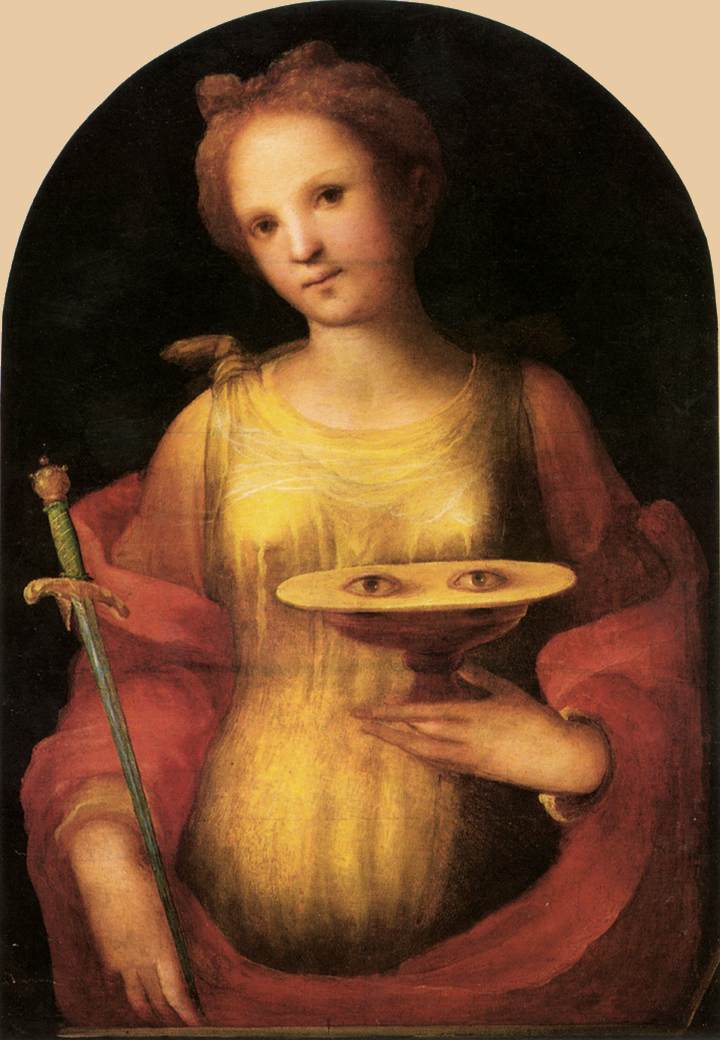
St. Lucy, after her eyes got gouged out during her martyrdom.
nothing else to give; I offer Him myself."
Antiphon for the Canticle of Zechariah from the Divine Office for the feast of St. Lucy.

This morning during my Holy Hour the antiphon above really stuck in my mind. It is fitting for Saint Lucy, since she is both virgin and martyr. She truly did give everything to God, both during her life and at the end of her life. By including this antiphon in Morning Prayer, the Church obviously means me to pray it, but the truth is I cannot honestly apply it to myself. In truth, I doubt anyone ever could strictly apply it to themselves, except for Jesus and the Blessed Mother. No one else can claim truly to have given everything to God. Even the greatest saints have held something back at one time or another. All are conscious of their sinfulness.

If this is true even of the greatest saints, how much more so of myself? I cannot even give him a full hour totally. Even thinking about this during my Holy Hour I noted the trend I have to be extremely distracted for about the first 50 minutes. It is generally only the last ten minutes or so that I really feel like I engage in on any affective level. The first 45-50 minutes are just me trying not to be distracted as I work through the Liturgy of the Hours. I cannot even claim ever to have given Him an undivided hour. Can I really claim to have "offered all in sacrifice?"

In thinking about this another similar experience came to mind. I have been doing a lot of kickboxing lately, working the heavy bag a couple of hours every week. I am right handed but I box left handed because I got into that habit when I first started out. My left hand would not learn to jab very well, so I just jabbed with my right and used my left for power punches. I also liked having that surprise power shot with the right, and I liked messing with right handed sparring partners who aren't used to fighting a southpaw.

In my sessions on the heavy bag I have been having trouble getting my left cross up to scratch. It doesn't have the speed or power that I want at first, it is slow and stiff. It takes about four or five rounds on the bag to get it snapping the way I want it to, and only then does the real practice begin.

I sometimes wonder if my distracted prayer isn't a bit like that. I only really get into the last bit because it takes me the first 45 minutes just to get warmed up. With the boxing the cause is fairly straightforward. A punch flies properly when it is loose. It starts from the feet, legs and hips and translates out from there to the end of the fist, but in order to do that the power must be generated in the large muscles of the lower body and transferred smoothly through the muscles and joints of the lower body. It isn't hard to teach those muscles all to fire. That takes about five minutes to learn. What takes much longer, years and years in fact, is teaching the other muscles not to fire. When I throw that punch, my body wants to tense up and push harder, thinking that will make my strike more powerful; but that simply does not work. Instead, muscles end up fighting each other, competing instead of cooperating. Instead of transferring smoothly back and forth between different groups at different points in the movement, all groups want to be controlling all parts of the punch. I have the strength. I can deadlift 400Lbs quite easily and do multiple sets with it. That is more than enough power to hit as hard as I want, if only I would stop getting in my own way.

This, ironically, is why small, lean fighters often hit with more force than large, muscular ones. They have less muscle to get tangled up with itself, and it is easier to train them to work in cooperation. This is the secret behind Bruce Lee's incredible"one-inch" punch that was reported to be able to knock a sumo-wrestler off his feet (note the guy in the picture is not a sumo-wrestler.)

To apply this to my prayer life, what the antiphon is talking about is a similar kind of totality, where every single part of me, body, mind, emotions, will are all engaged in just one thing. As with boxing, I am beginning to think that perhaps it is less a matter of training myself to do and more a matter of learning not to interfere. The simple decision of the will is there. I get up in the morning. I go to the chapel. I kneel down. I make the decision to pray, which is a response to the call of God to pray. That call is the power. That generates all the power needed to crash through any barrier or overcome any enemy, if only I wouldn't get in the way. But my mind refuses to be still. It wants to think, because when you are a mind that is all you know how to do. My body wants to move, because that is what a body does. My emotions want to feel things, because that is their only experience of life. My will wants to choose things, without knowing that all that is required is not to un-choose.

The truth is that the prayer is not any of these things. All of these things may enter into the prayer at any point, for a specific purpose and then they must be prepared to give their all in that moment, but they are not the prayer. The prayer is that single, downward rushing desire of God to come to me and dwell in me and make His home with me.

The rest is just me learning not to get in the way.

Tuesday, December 10, 2013

A Face That People Can Trust

Once, back in the Q course, I was standing in line at the drop zone. I had harnessed into my chute and was waiting for a jumpmaster to perform his prejump inspection. This is basically a head-to-toe examination of the harness and chute prior to getting on the aircraft, to ensure there are no deficiencies and everything is attached and kosher looking. When the jumpmaster noticed I was ready he came over and began his inspection.

If you take out the middle letters it doesn't count as a bad word.
Now, the JMPI (Jumpmaster Prejump Inspection) is a very quick and fluid process. The Jumpmaster's hands fly swiftly by rote over the same path every single time, and the only time they seem to be paying attention is when they find a deficiency. Especially on this particular jump, the jumpmaster was so unconcerned he was holding a conversation with me.

"Are you jumpmaster qualified?"

"No, Sergeant."

"Well you should be. You have one of those faces, you know? You just look like you know what you're doing. Turn around. That's the important thing. Bend, squat and hold. You don't actually have to know what you're doing, you just have to look like it. Have a good jump."

And he wandered off to the next jumper.

It is true though. By some trick of bone structure and muscle tension, my face when relaxed has always looked like I know what I am doing, which is totally ironic since in reality, at any given moment I am probably winging it. The odds of my actually knowing what I am doing are quite small.

Ryan Kraeger pre-mission photo, circa 2007
A case in point of that occurred in Afghanistan, toward the end of my rotation. I had been working at route clearance for the last six months of a fifteen month trip. (Route Clearance means we went searching for IED's and disarmed them when we found them. I was the guy with the mine detector.)

After six months I had found every one and not been blown up once, which is a good record to have, but I was getting burnt out. I was losing confidence in myself. You know the way you feel when you win five poker hands in a row, and you just don't want to bet anymore because you know the next one is going to be a flop? That's how I felt. Only by "poker hand" I meant "IED" and by "flop" I meant "red mist on the breeze."

I was also developing a deeper, stronger confidence in God. I was coming face to face with my own mortality and fallibility, and yet was still required to do my job, and so I was left with no recourse but to trust God. I did not particularly trust Him not to get me killed. His people have a way of meeting singularly inconvenient ends which sometimes involve explosions, and sometimes do not. How many practicing Catholics have been shot, bayoneted, burned, nuked or gassed in the last hundred years or so? Do you think their mothers weren't praying for them? Seriously, the founder of our Church was nailed to a stake and left to die. How should I expect special favors?

So I had no illusions that trusting God was some magic, IED-proof force field. Which didn't matter to me, because I was not afraid of dying. I knew that if I died, it would be because God thought I was done with whatever it was I was sent to do, and who am I to argue?

God must feel like this psychologist sometimes.
No, I did not fear death, I feared failure. I was afraid of making a bad call and letting the vehicles roll over a bomb and killing someone else. It was a call I made every day, and I was well aware how fallible I was. You never really know. It is one thing to trust God with your own life. It is another thing to trust him with someone else' life. It is another thing to trust Him with the things that really matter to us personally: projects we have invested in, plans we have made for the people we love, surefire ideas to save the world, etc. In a word, control.

It was this that I was called to surrender, the reputation for being right, the illusion of authority. I was learning to give up the illusion of control. There was a measure of irony in the fact that, while I barely trusted myself at all, but trusted God with everything, the other guys in the platoon barely trusted God at all, but trusted me with everything. I am sure God thought that was quite funny.

But in reality, isn't that part of the call of being Christian, to trust God on behalf of other people? It has become an increasingly important component of my prayer at any rate. I know that God is to be trusted. Other people do not, but for whatever reason they trust me. As long as there is a me in the equation this is an alarming concept, but if I can let go of the me and let God take over, then they are really trusting God. Praying for people has become something like an exercise in letting go of them. Simply trusting that God knows best, that He is in control, that even if He lets them die (which He certainly will eventually) He will not let them out of His sight. This is also how I pray for my atheist and agnostic friends. Even if they do not know or trust Him, I feel like it is helpful, perhaps even critical, for me to trust Him with them. Somehow I feel like it does them some good.

I don't know how, but if I am right thus far I don't really need to know how. It is enough to be going on with.

Saturday, December 7, 2013

The One Thing Necessary for the Triumph of Evil

In keeping with my last post, here is some food for thought that my little brother shared on facebook.

Granted, there is no point in jumping half cocked into a situation where you might end up getting stabbed or shot, and not do anyone any good. On the other hand, the sort of bullying shown in this video could easily have been stopped by nearly any college age adult with a half an ounce of confidence. People choose not to step in, not because of any reasonable fear of personal harm, but because of a kind of psychological and moral paralysis, which may be the subject of my next blog.

The decision about when and how to step in in more dangerous situations is a thornier question. I think I might do a blog on that as well.

In the meantime, I hope this video has given you some cause to think.

Tuesday, December 3, 2013

Why Chivalry Still Matters


To balance out my last post, I have always been an advocate of a modern chivalry, going so far as to write a book and a surfeit of blogs about it. Despite the fact that it is no longer a primary focus of mine, I still think it is both good and necessary. Make no mistake, the need for chivalry, for protection of women by men, is still very real in this world. However, a fake chivalry that thinks its duty fully discharged by having held the door or paid for a meal is not going to cut it. The only solution for a crime against women like that pictured to the left, is a real chivalry, with brains and balls, muscle and a soul of steel, and the willingness to suffer (or perhaps inflict) violence if necessary to protect the innocent. 


That  picture is an extreme, although not at all uncommon, example. Perhaps acid throwing and nose cutting happen only in Afghanistan or India or Timbuktu or some such outlandish place but I can almost guarantee that on your street, right now, there lives at least one battered woman or abused child. If you are a public school student I can promise you, you walk past a half dozen scenes of bullying every week. If you work in an office you probably witness at least one or two incidents of verbal abuse, sexual harassment or oppression a day. This is the field of modern chivalry.


Most of your cardboard armor "knights," whining and complaining that no damsel wants him to be her savior, endlessly going on and on about how chivalry is dead and feminism killed it, they are just not up to that challenge. Unless they stop living in a fantasy world and open their eyes and train themselves long and hard, they never will be.

Sunday, December 1, 2013

Chivalry and Charity

Recently my cousin posted a link on facebook to an article about chivalry which sparked a bit of a long comment thread on the subject. There were numerous pro and con arguments, but the only con argument against chivalry that seemed any good to me was the question my cousin had, that if chivalry is simply a matter of courtesy and serving other people, then how is it any different from Christian Charity? It is a just question, and I have been thinking about it quite a bit in the weeks since. Most of this post comes from that thread, but some is the result of those weeks of thought.

First of all, it is important to understand that they are not the same thing. Charity is supernatural, and the culmination of all virtues at their essence. Chivalry is a humanly defined collection of virtues. An analogy would be the difference between “Star” and “the big dipper.” “Star” is a concept which includes all possible aspects of the true essence of star, from the scientific to the poetic, discovered and undiscovered. “Big dipper” on the other hand, is our word for a specific group of stars which bear a certain relationship from our two dimensional view, but which would be meaningless viewed from nearly any other point in three dimensional space. This does not mean that the concept of “big dipper” is useless, especially for someone trying to find polar north without a compass, but if we ever go to another solar system and search the night sky for directions we may find ourselves hopelessly lost.

Chivalry is the same way. It is a human concept with a specific historical origin and evolution. It is also a word for a specific collection of virtues. These virtues differ from one time and place to another, but they historically have always included at least these three: some martial or at least athletic connotation; the idea of scholarly excellence in a general, non-specialized sense; and a certain mannerly and respectful way of treating others, with an emphasis on those in positions of vulnerability.

Chivalry is not about holiness; it is about self-improvement. It will not get you to heaven. (See John Cardinal Newman’s “Idea of a University.”) It may make earth more enjoyable but it will not save your soul. If diligently followed it will make you respectful, athletic, a respectable fighter, interesting, sophisticated, dignified and a great conversationalist (already we are far removed from the idea of chivalry as a portable doorman for highly manicured ladies). These are all good things, and well worth pursuing if you have the time and inclination. However, chivalry will not make you humble or compassionate. It is no guarantee that you will ever learn how to love.

Chivalry is particularly interested in the relation of men and women because of its origin in the middle ages. It originated (according to Brad Miner in “The Compleat Gentleman”) specifically as a means to teach big, rough, tough, skull-crushing, Saracen-gutting, half-barbarian warrior types to regard women as people with rights, rather than merely as property. The element of service to women is an attempt to subdue the aggressive, lawless and particularly masculine to service of order, beauty and peace. Holding doors for women is a somewhat pathetic remnant of that.

Since it is a man-made concept, it must evolve with the times, something that most of the “bringin’ chivalry back!” (BCB) crowd does not realize. A lot of BCB-ers lament the absence of damsels in distress because they feel that distressed damsels are necessary for them to be chivalrous. As long as the damsels get through life steadfastly refusing to be distressed, you can’t blame the boys in cardboard armor for being a little put out. 

 The fact is that somehow or other, women do in fact manage to get through doors, get into and out of cars, and procure food items for themselves, even when men are not around. They seem to do it rather well. Therefore, if holding doors and paying for dates is seen as the measure of what chivalry is, well, thanks but I have better things to do

A more mature chivalry sees women with a critically balance poetry. He sees what is, namely, that women now-a-days are not as exaggeratedly vulnerable and crying out for a rescuer as Sleeping Beauty and his behavior towards them respects that. On the other hand he also recognizes that the vulnerability that the Sleeping Beauty fairy tale symbolizes is not a bad thing. Vulnerability is worth fighting for. It is worthwhile to cherish and value that side of a woman, while recognizing that it is not her only side. She is a fellow shipwrecked passenger, just like I am, and her ability to be vulnerable and beautiful is one of the most powerful strengths she brings to this lonely island. It would be a shame if that were lost because there was no one around to value it.

You see, a truly chivalrous man knows that it is a good thing to treat a lady like a lady, and knows also that a “lady” is not a euphemism for spoiled brat. A true lady is a very dangerous and powerful person indeed. She is not a Disney princess. She is not a tame lioness.

But that is the long way round. At its best, chivalry like all other virtues must first resemble and then finally be drawn into charity if it is not to become obsolete. Charity is better. While chivalry is an exclusive virtue in that some people can develop it and some people cannot, charity requires only that you be willing to know and love the other and be known and loved. It is open to man, woman, child, old person, scholar and day worker, athlete and invalid, fat, skinny, strong, weak, genius or dunce. It is better to be even the littlest of lovers than it is to be the greatest of knights. 

However, in the last year or so I have not thought about practicing chivalry at all. I have gradually been shifting my focus towards striving after charity. This does not mean I think that my previous focus on chivalry is superseded. I think it was valuable and worthwhile, for several reasons. 

Firstly, it was the search for chivalry that brought me to the point where I could recognize that charity is superior. That was the most powerful draw for a man of my personality, and I think it could draw other men just as strongly. That is why I will certainly teach it if I ever have sons, or am in any way in charge of the education of boys.

 Secondly, I do not think that concentrating more on charity will make me less chivalrous. Quite the contrary, I believe it will fulfill and make complete the chivalry that I have been practicing for years, but, alas, have still not mastered.

And thirdly, charity is as individual as people are. Every human's love is different from every other human's love. Chivalry was the most influential part of the raw material, and it imparts a strong flavor or color to the shape that my charity will take, when by God's grace it is full grown.