Showing posts with label medic stuff. Show all posts

Thursday, August 14, 2014

Patient Interactions

-->
My favorite part of medicine is interacting with patients. My second favorite part is fitting the puzzle together, piecing all of the various bits of data from history, exam, labs and the literature to form a coherent image. For some providers, I suppose, that is the most exciting part. Dr. House comes to mind as an example of that disease oriented provider. Others are all about the procedures. They just enjoy getting hands on the patients, physically manipulating the diseased part, and providing healing that way. I suppose that category would include most surgeons. I find, however, that most patient encounters do not require much puzzling. Most are actually quite straightforward. Hardly of my patient encounters require procedures, although they are fun when they happen. However, every patient encounter includes an encounter with another human being. Sometimes these encounters are memorable, sometimes not. Sometimes they are fun, and sometimes they are not. Sometimes there is good rapport, and sometimes it seems that you are speaking totally different languages. Regardless, the encounter is always an encounter with the ineffable other of a human being who is not myself.
Tacoma is known for having a very high percentage of Asian populations. In fact, South Tacoma Way, one of my favorite strips for Asian cuisine, is informally called “South Korea Way.” Street signs are even labeled in Korean. Being a Special Forces soldier, my training includes a foreign language, which, in my case, is Korean. I would not say that I am fluent. I can order food, exchange pleasantries, and maybe chat a little bit about C. S. Lewis’ book “The Four Loves,” (I memorized a good deal of vocabulary for that book when I was preparing for my Korean speaking and listening test). It is not, however, to allow me to hold a conversation with ease with a native Korean speaker.
Several of my patients over the last two weeks were older Korean ladies, wives of Korean war veterans. I usually enjoy chatting with them a little, enough to say “Hello, how are you doing, where does it hurt?” One patient, in particular, was a very sad looking Korean lady who complained of fatigue, tiredness, pain, and heartburn. We talked with her for quite some time trying to come up with a list of her complaints and prioritize them, but she was a very listless and haphazard historian and she complained of confusion. Finally I asked, in Korean, “Sunsengnim (term of respect), do you get confused talking in Korean?” Her eyes widened and she repeated my question back to me in more correct vocabulary. I asked about her Korean friends, and she shook her head sadly.
“I not trusting Hanguk (Korean) peoples, they not sharing feeling. They nod yes, yes, when talk but later they like this behind you back,” she made a blabbing gesture with her hand. I asked if she had any American friends and she said, “I no likey Miguk (Americans) either. They just talking talking saying whatever come in they head. I not like that.”
While the doctor typed his note we chatted about this and that, and she slowly became more and more at ease. It was more “konglish” than either Korean or English. I learned that she was very lonely, and almost always sad. Her house had been broken into (she lived alone) and she just felt nervous and unsafe. She gave me an impromptu lesson in Korean language, history and folklore, and explained why the Korean number 4 “sa” is considered unlucky. I very much doubt we were able to provide any lasting relief for her symptoms, as I strongly suspect most of them had a behavioral or social health basis. She was a sad, lonely old lady, and she needed a friend and a hug more than she needed pain medications, but her fears and isolation kept her from those, so pain medication was all she could understand. However, she seemed to be put at ease by my broken attempts to speak and listen to her in her own language, and there was even something like a half ghost of a smile on her face when we shook hands goodbye.
Was that a good interaction? A positive one? I would not classify it as such, objectively. We learned very little to point our way to a treatment plan, and I do not have much hope that her symptoms will ever be resolved strictly by medicine. However, the attempt to reach out to her was just a little less negative than it otherwise would have been, and I think therefore it was more than worth it.
Another Korean lady the same day came in for coughing and post nasal drip, but she refused to believe that she had allergies. She was very upset at not being able to see her regular doctor (who was on maternity leave) and she denied ever having taken allergy medicine that her doctor had prescribed her. “I throw that medicine away, because I not like takey the pills!” It was hard not to laugh. She was about four feet tall and about two inches in diameter and bound and determined that something was wrong with her, because she could not stop coughing or sneezing, but it was NOT allergies! Bless her heart!
No amount of cajoling in English or Korean could convince her that, yes, in fact she very likely did have allergies, and it was perfectly normal and treatable. We tried to get her to promise at least to try the allergy medicine. When she would not we tried to sneak it into her medicine list without telling her what it was for! We said, “Oh, that’s to make you sniffles stop,” which was true, but she would have none of it. “I not takey the pills.”
Finally when the visit was over she stood up and said, “Thisa better working. You not makey me better I go to Korean doctor!” I felt like saying, “Fine! Go to a Korean doctor! What sense does it make to come to a western doctor and then refuse to take western medicines?” She never got angry, she just laughed at us like we were too ridiculous for believing that she was so weak that things like allergies and pills could apply to her. She did, however, tell us most emphatically that kimchi was going to keep us young and healthy and that I was going to live longer than the doctor because I loved kimchi and he “only likey the pizza!” He had never said that he didn’t like kimchi, he simply had never tried it, but in her mind that lumped him in with all the other pizza eating Miguks!
I cannot get angry at patients like that. I love their eccentricity, and I respect their autonomy. God bless them, if they want to grow old and cantankerous and get their kicks out of making fun of western medicine, more power to them. I hope I have enough spark left in me when I am old to be grumpy and funny like that.
The patients I feel sorry for are like the 60 year old man who came in for a regular checkup. In the course of the interview he mentioned having a new feeling of shortness of breath whenever he walked up hill. This prompted a deeper interview, a physical exam, an EKG, and the end result was that he was going home with a bottle of nitro, a bottle of baby aspirin, and a follow up appointment for an exercise stress test. As the appointment progressed and the diagnosis took shape, I could see the growing possibility reflected in his face and posture. His shoulders sank, more and more, his face became more and more bewildered, distant, afraid. It was a relief when the doctor finally said the word: “Heart disease.”
“We need to make sure you don’t have heart disease.” Amazing how we all knew that was what we were talking about, but we were reluctant to say it.
“Are you doing okay?” I asked.
He looked up at me. “I guess. It’s just I have a lot going on at home. I have family troubles, and my dad is not doing too well, and now this.”
“A hell of a thing,” I said.
“A hell of a thing” He agreed. His dad’s brothers had died in their early sixties of heart attacks. His face fell even further when he found that he could not work out until after the stress test, because of the risk of having another incident. “I can’t go to the gym?” His build spoke for itself. Despite his slight beer gut, his shoulders and arms were thick and powerful. He had been lifting his entire life. Now he would have to give it up, perhaps for a very long time, perhaps forever. Not only that, but because Viagra reacts synergistically with nitroglycerin, and can cause a catastrophic drop in blood pressure, he could not take Viagra until after the stress test, when we would have a better plan.
He looked at the doctor. He looked at me. “No weight lifting? And now you tell me no sex? Doc, what’s the point?”
At times like this you feel guilty about the clock, ticking away, reminding us that his appointment was only supposed to last twenty minutes, and that is long since up. How do you kick him out the door so the next patient can come in and tell us all about his acne and how it is affecting his social life?
I might be getting old, or maybe my parents were just poor and backwards (poor they certainly were) but it never would have occurred to them to take us to the doctor for acne, especially not acne so mild as to be invisible under long, thick black hair. There were a dozen or so cystic comadones around the hairline on his forehead, and another dozen along his hairline in the back. This rates a trip to the doctor?
And yet, it is a big deal to him. It never was to me, (I could have cared less for popularity at that age) and that may make it difficult to relate. One hopes that he grows to be a little less concerned about such things as he gets older and gains perspective, but he is not older. He is a teenager. This is where he is, this is important, and in its own way it is as devastating to him as a tumor would be to me. Why should I allow my age and experience to deprive me of empathy for his lack of age and experience? Would not that be shallow mindedness without even the excuse of youth and ignorance? And how difficult is it to prescribe some erythromycin face wash and an exfoliant? We sympathize with many, many older patients who are just as silly, and with less excuse. Certainly in my life many, many older and wiser people have put up with my ignorance and silliness. Shall I refuse to do the same for him?
So I resisted the urge to write him a script for “soap and water” or “a nice cup of man the heck up!” and provided one for face wash instead. I wish him well at his next high school social function. He was a nice kid, after all.
In reviewing these patient encounters I find it very difficult to classify them as “positive” or “negative.” That is more or less to be expected. Any encounter with another human being is essentially an encounter with the unknown. We do not hear the other perfectly, we do not communicate perfectly. The best I think we may expect of ourselves is the continual effort to be present; beyond all filters, preconceptions, contexts and languages, present for the other to be the other. Is it possible? Probably not. It is a worthy effort, I think, for only thus is any real meeting possible between humans. So, in any encounter, there is always more that could have been achieved, or less that could have been said badly, or some aspect that could have been improved. It is never perfect. The mistake, I think, is to try to reduce it to a technique. Technique is a tool, body language, active listening, participatory conversation techniques, or what have you. The essence, however, is goodwill towards the other. It is goodwill that will overcome all barriers, and hopefully shine through our clumsy, inept attempts at using our various languages, to communicate with something essential in the other person. On that level, perhaps we may even hope that some kind of real healing might occur.

Thursday, November 7, 2013

Old People Are More...

My two favorite patient populations to work with have always been old people and children. Of course I have always loved interacting with kids, even when I was one myself. In some respects I still am one. It keeps me sane.

I was surprised when I started working with old people in my medical rotations to find that I really liked them. Perhaps they appeal to me because of their extreme vulnerability, which in America is often pretty great and is getting worse. Children are almost never left unprotected in the healthcare system. Old people very often are. If I can interact with an old person who feels abandoned, unvalued and unloved, and just for a few minutes or an hour or so I can listen to their story and let them know that they are still worth my time and patience, I like to think that I am fighting back against the hatred that society has for the ones who no longer make money.

But vulnerability is not the only reason they appeal to me. Underneath the vulnerability I see something else, which I am not sure how to describe. The only word I can think of is "rootedness." They are not less than the young patients, they are more. Old people have already become. I am explaining this very badly.

My fiancee and I agree that in general there are two kinds of old patients. There are terrible old patients and there are awesome old patients. There are no average old patients. (This is not including patients with dementia or Alzheimers or some other primary mind altering condition. They are a different story altogether.)

Once in the ER, on the exact same day on opposite sides of the hall I had two patients, both older gentleman, one in his late 60's the other in his early 80's. One had come in for a fall in his garage, and spent his whole visit complaining about how much pain he was in, and how terrible the service was, and how he had to tell his story so many times, all the while explaining how tough he was and what a high pain tolerance he had. I was examining him and he winced and screamed like I was stabbing him every time he saw me come near where the injuries were.

The other gentleman, the older one, had cut his leg with a chain saw a week prior and had calmly driven in to the hospital and gotten it stitched up (bad call on the part of whoever stitched it). Now it was closed, but there was a huge, angry, red abscess cooking in the wound pocket which had not been allowed to heal from the bottom up as it should. His whole front thigh was in pain, but he was sitting upright, quiet, patient, chatting and telling stories of his exploits and the strange things he saw back in the War. We squeezed every drop of pus out of that wound by force and then mashed on it until there was not one little pocket left undisturbed. He turned a few shades paler (he was a black gentleman) but then he looked at the huge glob of pus and clot we had expressed and jokingly asked whether he should give it a name.

Old patients are not less of anything than their younger counterparts. They are always more. They are either courageous beyond belief, or whiny beyond belief. They are either interesting in ways that no younger person could ever be, or incredibly dull. They are either utterly loving and self-giving, or they are exasperatingly selfish. The elderly gentleman with no teeth, rheumy eyes and unsteady feet is still more courteous and gentlemanly (and charming, my fiancee would say) than any suave, cultured man of the world. The dirty old man is more lecherous than any horny teenager would ever dare to be. That peaceful old lady with the curly white perm is more completely unselfish in her every thought than I have ever been at my most heroic. That other lady in room three is more vocally and rudely inconsiderate than I have been since I was a baby.

Perhaps my fiancee and I have this perspective because we see them under stress. The stress may reveal traits that do not show in day-to-day life. However, I think there is another reason. I think that old people live in extremes like that because they have spent their whole lives becoming that thing or the other. They have either been practicing strength and courage and courtesy and become very good at it, or they have been practicing weakness, manipulation and whining their whole lives and have gotten very good at that.

Whichever the case, it does not change how I treat them. If anything, I have to put more effort into the whiny patients. I don't know their whole life story (although I probably will if I don't watch out) and I don't know what they have been through. I don't know what they are afraid of. They probably don't know what they are afraid of, and if they have not faced up to it in the last 70 years or so, odds are they won't do it in the time they have left. I pray that they do, though. Even at the end of our lives, all of us are still becoming. Right up until the very end, change is still possible.

At any rate, it makes me take a good hard look at my life. I ask myself, what kind of old person am I becoming? Am I becoming a holy terror? Or am I becoming that awesome old dude who can crack jokes while getting an abscess drained without anesthetic? It is worth thinking about.

Tuesday, October 1, 2013

The Car without a Driver

In one of my college course that I am currently doing, (one of the reasons that I am so absent from this blog of late) I was asked the question, "How important is spirituality to your overall well-being?"

This was my response. (You see how I cheated there? Wrote a blogpost and a school post in one fell swoop? heck yeah! That is called time management!)

Also, here is my latest post over at Ignitum Today: http://www.ignitumtoday.com/2013/09/30/beautiful-day/


To ask how important spirituality is to your overall well being is similar to asking how important health is to being healthy. People often think, speak, and even behave as if spirituality was an optional add-on, like seat warmers in an SUV: nice if you have the time and money for such things and happen to be into it. For those of us who generate our own body heat and are always warm it is nothing more than a luxury, and an expensive one at that.

This attitude, however, misses the meaning of the word. Asking whether spirituality is necessary for well being is like asking whether a car needs a driver. On one hand, the answer is no. A car will be a car and will, presumably, run just as well without a driver as with one, assuming that someone turns the key and leaves it idling in a parking lot. The engine, brakes, lights and air-conditioning will all be fully functional, but what is the point?

Without a driver and a destination to go to, or even just the capacity to enjoy moving and seeing sights, a car makes no sense.

And so, in the discussion of the role of spirituality in healthcare, a strict, logical analysis finds us reversing our terms, if we are honest. It is not whether or not spirituality has a place in healthcare. It is what place does healthcare have in spirituality. Just like we don't ask what the role of a driver in a care should be, we ask how best to design a car to fit the driver.

Unless it finds its place within a total, integrated vision of well-being and purpose, of meaning and truth and worth, healthcare is a waste of time. At best it tell us how to keep the body healthy, and even at that it falls short. What is certain, however, is that it can never tell us whyto keep the body healthy. To answer that we must ask for meaning in life, and any serious quest for meaning is always and essentially a spiritual question.

Thus the correst question is not what role spirituality plays in well-being, but what role well-being plays in the life of the spirit.

Monday, October 15, 2012

Thai Women


Part one in a series of eight posts written back in April of 2012 during and after a trip to Thailand to teach advanced first aid.

 So here I am, in Thailand, teaching first aid to Thai police officers. Probably the second most awesome assignment I have had in the military.

This last group of students that came through was about one third female. While a few of these women were older, (forties and up) most were in their early to mid-twenties and pretty. They ranged from girl-next-door look, to exotic willowy beauty, to sweetheart smiles and attitudes, all with Thai forms and faces. I must say, in general, Thai women are very good looking. There is the normal variation in shape and face that you would expect in any society, but in general they are a pretty pleasant looking bunch. Either that or I am easy to please. The other Americans tend to be a lot more critical than I am about looks. They notice things that I don’t, certainly. “That one’s eyes are too far apart” or “Her mouth is too wide” or “She doesn’t shave her legs.” It’s a curious spectrum. On one end there is the kind of guy who criticizes all of them and would sleep with any of them.  On the other end is me, who thinks they are all beautiful and wouldn’t sleep with any of them.

At any rate, the class had a very large population of young and attractive females. The four older ones sat in the first two rows, and all the rest sat further back in the classroom. For some reason when this class was divided up into groups, I got the first row and a half with the four older ladies, and the other two instructors got the rest. My interpreter noticed this change in format as well and pointed it out to me, to which I just shrugged. I’m here to teach, not find a girlfriend. Who knows if they even saw that when the class was broken into groups? It’s not like the other instructors assigned seats, they just divided up the class into blocks. Perhaps they saw it at the time, or perhaps they only saw it later. If they assumed I wouldn’t care they were quite correct. If they assumed I wouldn’t notice, though, they don’t know me.

This led to at least one hilarious day in class though. We had broken down into small groups for practice, and we were going to be like that all day. One of the primary instructors wasn’t able to be there that day, so my assistant took over his group for the day. Then the regular instructor’s assistant pitched in. Then the assistant from the other instructor went over to help. One of the women in my group said something in Thai that made all the other women laugh. When I asked my interpreter what she said he answered, “They say, ‘All the Americans go to that group because the girls are young and pretty. They not want to come here because we too old.” I laughed about it and went back to training, but not ten minutes later in walks our boss, A. You have to understand one thing about A. All the Asian women (and more than a few Asian men) think he is just gorgeous. It’s partly because he always dresses and speaks neatly and respectfully, and partly because he is a little over six feet tall, with an athletic build and long blond hair (always in a boy-scout part over his left temple). He has been likened to Tom Cruise, only not in midget size. He has also been likened to Captain America. He was even asked by two random teenage schoolgirls to pose with them for a photograph outside a Buddhist Temple in Bangkok. (I think they were actually asking all three of the Americans there, but I managed to skate smoothly out of that awkward situation and totally left him to the wolves.) So as he walked past my group all the ladies caught their breath and watched him with adoring eyes, but he did not even glance their way. He kept right on walking up the steps to the next group. All my female students let out a collective yell of mock anguish.
The best part was that A had not a single clue that any of this was going on. Being the consummate professional that he is, he had no intention of singling any group out or offending anyone, and had no idea of the conversation that had occurred prior to his entrance. He just knew that one of the groups was without its primary instructor so he walked directly over to it to see how they were doing, and in so doing, broke four hearts in one fell swoop.

Friday, May 18, 2012

The Power of the Powerless

I remember reading a story about a rather wealthy Indian lady who volunteered to work for Mother Teresa for a day, back in the years before Mother Teresa was an international celebrity. This Indian lady arrived at the clinic, which was a house for the dying, and was instantly overwhelmed by what she saw, heard and smelled. I know how she felt, too. Walking into a place like that is an instant sensory barrage of horror and evil. The evil, ugliness and pain are all very sensory phenomena, with their accompanying groans and screams, odors and wounds. The peace and love that the patients experience for the first time in their lives is much harder to see. The sight of raw flesh of a beggar who got run over by a truck is easier to notice than the fact that his wounds have been painstakingly cleaned of dirt, maggots and infection;  emaciated arms and ribs of a man who should weigh 70 kgs but instead weighs barely 30kgs hide the fact that he has just received the first good meal of his life, spoonfed by a woman who has dedicated her life to loving him; the smell of a human being in total kidney failure when his uric wastes are oozing through his pores on his skin disguises the fact that he has just been bathed today for the first time in his life. All of these things are a shock to the system. Even a trained and experienced medical practitioner can be overwhelmed walking into such a scene. Where do you start? What do you do? But this rich lady was a lay person, just an upper caste woman who had a kind urge and decided to volunteer for a day. I can only imagine what she must have been feeling as she stood there, surrounded by the obvious horror of human suffering. She must have been terrified, bewildered, filled with sorrow and helplessness. She must have wanted to turn around, run right back out the door, and never come back.

Fortunately there was something else at work, subtly, quietly, faithfully hidden under the obvious horror. Mother Teresa took this lady by the hand and led her to the most heartbreaking patient of all. A newborn infant was lying on a cushion, alone. Perhaps his parents had abandoned him, or perhaps they were dead. This was not a healthy baby. He was lethargic and emaciated. He did not cry or flail his tiny arms around. He did not startle the way a normal baby should, or grasp with his hands, or even suckle when a nipple or finger was put to his lips. He just lay there with his arms and legs spread out limply around him, breathing with the halting, abrupt, shallow gasps of a baby for whom simply breathing takes too much energy to be worthwhile.

Mother Teresa led the rich lady to this baby and told her simply to pick the baby up and hold him and love him for the few minutes or hours he had left to live. The rich lady protested that she couldn't possibly do that. It would surely break her heart. Mother Teresa only repeated her invitation, and went about her work. Left there in front of the dying infant the rich lady made a choice. She reached down and took that baby in her arms and held him. For the rest of the day she did nothing but love that baby as hard as she could until finally he died in her arms. And her heart broke, but not with anguish as she had expected. It broke with love.

I read this as I was in the first half of the SF medic training course, and it forever changed my view of medicine and healing. As healthcare providers we are trained to save lives. Our thought and energy are bent on staving off death for as long as we can, prolonging life, reducing pain, preventing or mitigating disabilities. All true healers have this goal, but all of us inevitably face the truth that our patients are going to die. Put it off as long as we can, prescribe what we will, in the end death will win. We can only delay it. Sometimes we can delay it for years. Sometimes only for minutes. Sometimes the patient is already dead, but their body just hasn't figured that out yet.

Faced with this truth, each health care provider, from the lowest EMTB to the Surgeon General (who generally does very little surgery from what I hear) has to find his own way of dealing with it. Some choose to ignore it. Some simply shrug their shoulder and move on. Some stop caring eventually. But in Mother Teresa's radical and almost unforgiveable request I believe I have seen the only true way forward. We must look deeply into the horror of death and see past it to the subtle, patient, silent work of love which is operating underneath the horror and pain, stronger and older and wiser than them. In the truly authentic Catholic approach to healthcare there is the acknowledgment that the patient will die, and the deeper knowledge that love is stronger than death. Even if the patient will only live for a few seconds, those few seconds can be lived with dignity. They can be filled with life and love and peace, if someone is brave enough to let God use them to be that gift. Such moments are never wasted.

All of this went through my mind when I saw this video by Tammy Ruiz a Registered Nurse who specializes in Perinatal Bereavement and Perinatal Hospice. I am not at all ashamed to admit that I couldn't watch the full video without tears in my eyes. The work she does is beautiful, heroic and necessary, and alas, all too rare.


Please watch the video and pass it on particularly to any medical proffessionals who are involved in birth and perinatal care. Pray for Mrs. Ruiz and the continuation of her vocation, which is truly a call within a call. Take the time to celebrate life in whatever way you can. This is a solid, concrete answer to the culture of death and a joyful affirmation of the infinite value of every single human person, no matter how small.

Go here to read Mrs. Ruiz's own words on her work.


(The Title of this post is taken from the title of the amazing book by Christopher De Vinck.)

Monday, November 21, 2011

Comfort Camping

My weekend in the woods was excellent. It rained cats and dogs the first day, and part of the first night. After that it cleared and after the first two nights it warmed up as well. I am not used to using a tent in the field, so I was a little surprised at how much of a difference it makes, but I think I’m probably going to invest in a hammock with a rain screen for my future comfort camping trips.

I feel like St. Paul, knowing how to get by with a lot or a little. I’ve slept in a torrential downpour with nothing but the clothes on my back, and I’ve slept in big tents, little tents, cabins, apartments, houses, guest rooms, hotels, airplanes, Humvee seats, and even cars.

The main difference between tactical camping and comfort camping is how quickly you can pack up. With tactical camping you have to be ready to go in an instant, which means that you don’t unpack anything you don’t absolutely need, you don’t bring anything you don’t absolutely need, and you go where you have to, when you have to. With comfort camping you can take your time picking up and moving, so you can spread out a bit. You can pitch a tent, start a fire (no need to worry about it giving away your position. You can sit around that fire and chat with the guys, or read a book. It is a remnant of my tactical habits that I don’t like to go camping with more than I can put in one rucksack and walk out with. I guess what I like doing is backpacking. On this trip, though, I brought my 44 Kg kettlebell. I can throw it up on top of the ruck and walk the whole thing out if I need to, although it would be slow. However, I needed to keep up some kind of workout routine while I was out there. As it turned out I had time to use it more than once, and time to go on a couple of runs.

Most of the time we just sat around and read books or talked. I finished Dubay’s “Evidential Power of Beauty,” and Nelson Mandela’s Autobiography, as well as both of the Little House on the Prairie books I brought, and started “The Brothers Karamazov.” That’s going to be quite a while to get through. It’s 900 pages long, and it took me hours of steady work just to get through the first 100 pages or so. I usually average 80-100 pages an hour. Russians! But it is good. I am enjoying it slowly.

I also started “The Image of Beatrice” by Charles Williams, a contemporary of C.S.Lewis and J.R.R. Tolkein. I’ve read two of his novels (“Descent into Hell” was easily the most understandable and terrifying portrayal of hell I’ve ever read.) I’ve also read his “Outlines of Romantic Theology” which was both beautiful and demandingly coherent. I am somewhat ashamed to admit that I’ve never read more of Dante than “Inferno” and from reading Williams I am inclined to believe I have never really even read that much. Thus far I am especially impressed by his blending of supernatural, mystical and even romantic awareness, with rigorous, clear sighted realism. He does what I aspire to do, seeing and knowing the world with every faculty of his being, heart and mind, body and soul. His distinction between the way of rejection and the way of affirmation as opposite but complementary aspects of the Christian life is also a brave thought. It was kind of an en-passant thing thus far, but it rises from his holistic awareness of creation. It is a concretization of ideas I’ve been working through recently, but too much to go into at the end of a casual blog post.

Man, books are just not as much fun without someone to talk them over with. The trouble is, no one around here reads the same books I do. You miss something when a book doesn’t go through you. People are like rivers. We are meant to take in good things but not to hold on to them. If they don’t move through us and flow on in blessings to other people they stagnate and die. Fortunately there are many, many ways for blessings to flow on.


We also had a few patients, myself and the other medics: sprains, strains, muscle and joint aches, and even a stick in the eye and FOOSH (Fall Over Outstretched Hand). A lot of ibuprophen, ice, ace wraps etc. A couple of ER transfers for x-rays. Nothing too spectacular. And of course, there are the feet. The never ending cycle of dirty feet after every event with blisters to be trimmed and dressed, nails to be cut, advice to be given, an occasional lecture about proper foot care. Really, if you maintain your feet properly you should never need to see a medic for them. I never have, although I have been gifted with very hard feet. On the other hand, I like doing foot care. It may sound strange, but I do. I like all aspects of patient care, but there is something about feet, hands and eyes that really appeals to me. I marvel at the amazing coolness of these structures. I also learned that I’m never going out to do med coverage again without my iris scissors. Trauma shears are just not the right tool for trimming blisters. As a matter of fact, once I get my whole minor surgical kit assembled, it is going to be my constant companion.

This is me and one of the other medics out in the field, chilling out. Someone got this with a cell phone while I was doing my morning bible reading and making oatmeal. Notice the product placement I am doing. SF soldiers use domino sugar.


Should I get paid for that?

Monday, October 3, 2011

Patients are More Fun when they Aren't Drama Queens

One evening a little girl came into the ER. She was about nine years old, and she had fallen on her outstretched hand while roller-blading. Her right arm was in a sling and she had abrasions on both her knees, but what really struck me when I walked in the room was the fact that she was sitting contentedly and quietly on the edge of the gurney, kicking her legs and looking around with interest. She was little and cute in the way that only little girls are, with messy brown hair done up in a sort of pigtail. She was still wearing shorts and a t-shirt, although someone had thrown a man’s zipper jacket over her shoulders, because the room was cold. Her parents were standing on either side of her, looking anxious, but she had a bright, intent, wide awake look. Her eyes were open all the way and a little extra as if she was perpetually amazed that there was so much in the world to see. She grinned at me as I walked into the room in my scrubs with my beard and that reminded me just how awesome my job was.


“Hello,” I said cheerfully. “What brings you in here tonight?”

“Oh,” she said casually, as if it had just suddenly occurred to her, “I fell while I was roller blading.” Her voice was cute too, very high pitched and squeaky. She said it with a perky attitude like, “Oh, if you must know. It’s probably not even worth mentioning, but you asked.”

I knelt down in front of her and examined her knees very carefully. “Hmmm, yes, I see. Wow. Well, you know, I think we can take care of this. I can call a surgeon and well get you scheduled in. We’ll probably take them off right about here.” I made a slashing motion across her legs right above her knees.

She laughed and squealed, “No!”

“What? You don’t want us to take off your legs? Really? Then why are you here?”

“This!” she laughed and held out her arm in the sling.

“Ohhhhhhhhhh!” I nodded, because it was all so clear now. “So that’s why your arm is in a sling. Oh, I get it. Okay, so what happened to that?”

“I fell on it,” she giggled.

I got her to describe how she had landed, and to point out exactly where it hurt, but she assured me that it didn’t hurt very much at all. I made her go through all her ranges of movement with her wrist and elbow, and then poked and prodded and pinched and squeezed. “Does it hurt here?”

“Nope.”

“Does it hurt here?”

“Nope.”

“Does it hurt here?”

“Nope.”

“How about here?”

“Not really.”

“You know what? I’m not even going to ask you any more questions, because you’re too tough. You could probably be lying on the floor with your hand cut off and I’d ask, ‘Does it hurt’ and you’d say, “No, not really’.” I said the last part in a high, squeaky voice to illustrate how she would say it.

She just laughed at me. Her parents relaxed a little bit when I explained to them that she might have a small fracture but it didn’t look serious and we’d get some x-rays to see exactly what was going on.

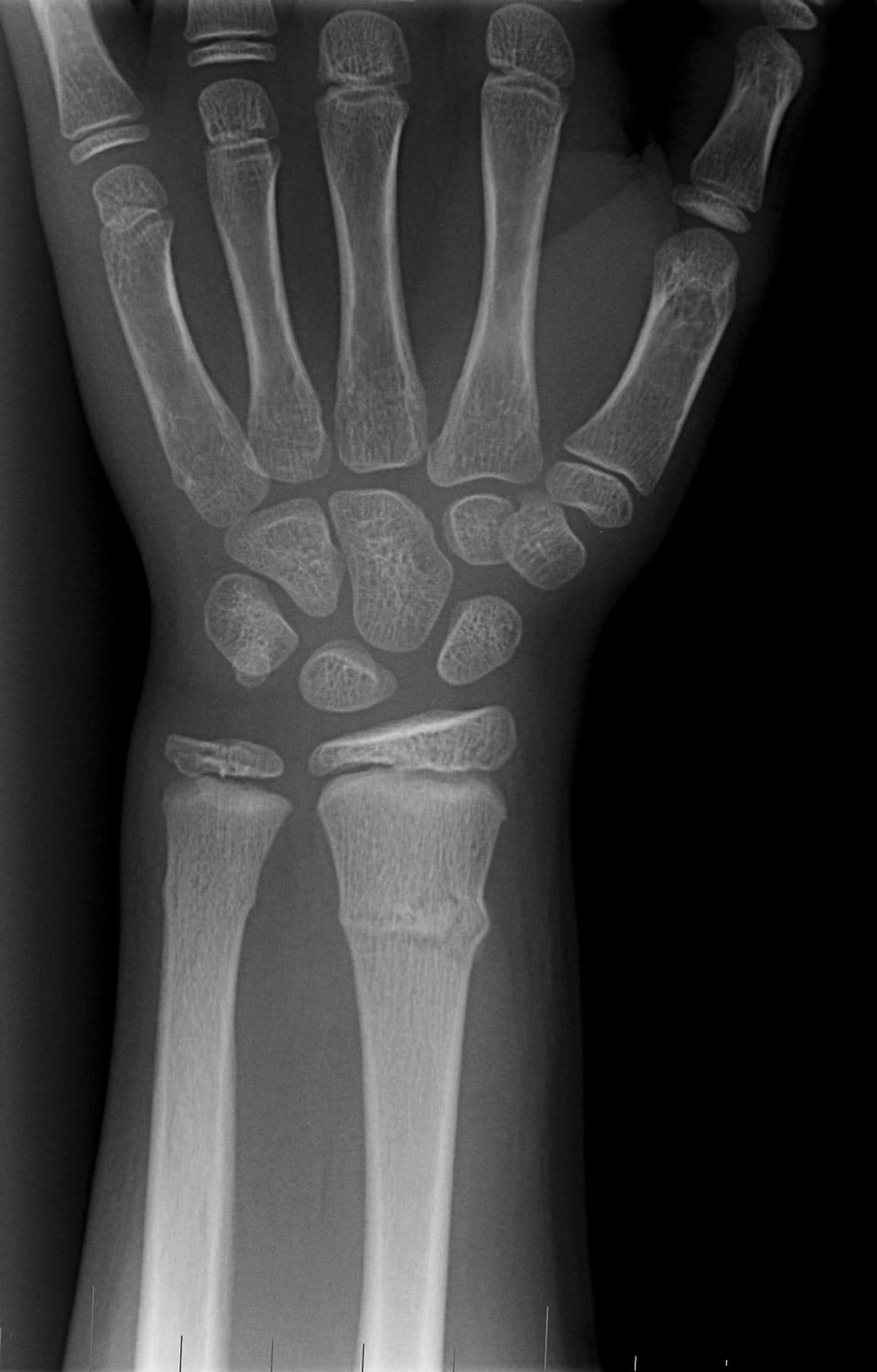
For an adult I wouldn’t even have needed an x-ray, although in a civilian hospital I probably would have gotten one just because it’s expected. Since she was a child, though, I wanted to make sure there was no crack in the growth plate. In the ends of every bone in a child’s body is a thin plate of cartilage sandwiched between the end (epiphysis) and shaft (diaphysis). The area where it attaches is called the metaphysis. As the child grows the cartilage grows and gets longer and longer, while at the same time it is being replaced by bone which does not grow. At some point, usually in the teen years, the bone replacement catches up with the cartilage growth and then that limb stops growing. When this happens in all bones of the body the person has reached his or her full height. However, if the plate is damaged while the child is still growing this can cause the growth to be lopsided or deformed or even to stop altogether. Hence the reason I ordered an x-ray.

As it turned out her growth plates were fine. The only damage was a torus fracture of the radius and ulna. Another characteristic of children’s bones is that they are softer and more flexible than an adult’s bones. Under stress they tend to bend and wrinkle rather than crack, somewhat analogous to the difference between a green twig and a dry stick. A torus fracture (also known as a buckle fracture) occurs when the outer layer of the bone, the cortex, wrinkles under pressure. It's pretty easy to see in this example from medscape. Follow the long bones up towards the wrist and you will see a buckle in each side of the bone. Hers looked very similar. She thought it was pretty cool that she could see it on the x-ray.

So we put her in a short arm splint to immobilize the wrist and signed her up for an orthopedic consult a week later. She was still chatting it up with the nurse as she fitted the splint, and I just had to go in to watch. If only all my patients had a sense of humor like that.

Tuesday, September 27, 2011

Scope of Practice

One night the EMS brought in a girl who was found unresponsive in her home. By the time she arrived at the ER she was answering questions, mostly appropriately, albeit with a significant delay. We were able to get a complete but contradictory history from her. She denied remembering anything, although she said she had had one drink and some marijuana with her friends that morning. We told her this looked like a drug overdose but she didn’t respond to that. She was a very pretty 21 year old, but she was far too thin for her body type and her forearms were crisscrossed by dozens of fine white scars. Physical exam was mostly unremarkable, except for a general lethargy and delayed/weakened motor responses in her extremities, and her pupils which were pinpointed, no focused and sluggishly reactive to light. She did not have the ability to follow a light with her eyes. All ocular movement was erratic and saltatory.


We did a urinalysis (UA) tox screen on her and it came back hot for barbiturates. Looking back in her file I found that this was her fourth time in the ER for prescription drug use. To top it all off, she was a pharmacy tech.

We had a long discussion with the ER doc about what we could do. We were all agreed that she shouldn’t be working in a pharmacy, but he said there was nothing we could do without violating patient doctor privilege. I argued that the laws contain a clause that states that if the patient is in imminent danger of causing harm to herself or others we not only have a right but a responsibility to report it to the appropriate authorities. In my view if a druggy is handing out drugs, her dipping into her own stock is the least of my worries. My worry is that she’ll be high at work and she’ll mislabel a bottle or put the wrong pills in it, or the wrong dose, or give it to the wrong patient and that could literally kill someone. Has it happened yet? No. I don’t think waiting for it to happen is a good plan. She needs to get fired for everyone else’s safety.

And what about her? Why the drugs and the alcohol and the cutting? Her mother showed up at the ER and wanted to take her home against her will. The charge nurse explained to her that we could not release her into anyone’s custody because she was not a minor. We could not keep her if she didn’t want to leave, we could not sign her over to her mother if she didn’t want to go. Her mother argued back, unable to see the plain facts of the situation through her grief and frustration. Didn’t we see that if she went back to her own house she would just get stuck with her friends again, and these friends were really bad. It was all their fault her daughter was doing drugs. If the patient could come home with her she (the mother) would keep the bad influences out of her life and she would turn around. Why couldn’t we just see that?

I couldn’t help but wonder, if that parental love hasn’t been sufficient thus far, what makes her think it’s going to become magically effective now? Regardless, legally there was nothing we could do. Like it or not, she was 21 years old. She was legally responsible for her own decisions and we could no more remand her into her mother’s custody than we could detox her. She was not in danger of her life. She was not overdosed, she was just stoned. That’s what those drugs are supposed to do. Even if she had been in danger the only treatment is to stick a tube in her stomach and pump out any pills that haven’t been absorbed, dilute with activated charcoal and support heart rate and respirations until the effects wear off.

What was up with her? The problem was far beyond emergency room scope of practice. Did her parents not love her? Had she been abused as a child? Had she not been able to find any good friends? Whatever the myriad single elements that made it up, they all came to one thing. The problem was that she had a deep, throbbing, aching, abysmal hole in the depths of her soul. That is beyond my scope of practice.

Thursday, September 1, 2011

The Shepherd

I had a man come into the ER one day. He was 94 years old. He had had diarrhea for two days, and then that morning he had felt tired and drowsy. So much so that he didn’t go out to walk his sheep to pasture and watch them all day, as he had done every day for nearly a century, with hardly any breaks. His daughter had gotten nervous and brought him into the ER. He spoke very little English, but he told his story with no frills and no fuss. It was not a big deal to him. His daughter supplied the nervousness. We drew some blood to check for all the usual suspects, i.e. infection, diabetes, anemia, etc. We hooked him up to a line of normal saline because we figured after two days of diarrhea he would be a bit dehydrated. Then we got a 12 lead EKG, which showed a rhythm that many 50 year olds would envy.


You have to picture him as I saw him, to understand. He was old, with a typical broad, Navajo face burned almost coffee brown from years of weather. He was very tall. I would bet he was once over six feet, and even now he stood with very little stoop and was as tall as I was. He wore tight jeans and cowboy boots, and a belt with an enormous buckle, a flannel button up shirt and a white cowboy hat. All his clothes were well worn, but clean, as if he had gotten dressed up to come to the hospital. When I went to look for a vein to stick him with the IV I saw that his arms were still thick and ropy, with great, gnarly veins like worms coursing under splotchy brown skin. He had the same perpetual farmer’s tan my Dad and Grandfather always had. He sat bolt upright on the end of the bed, kicking his legs like an impatient two year old, until we asked him to slide back against the raised head of the bed. He hopped his feet up onto the end of the bed and scooted on back with ease and when I asked him, through his daughter as an interpreter, whether that had made him tired, he took a deep, exaggerated breath and shook his head with studied nonchalance. “No.”

Bless his heart, that old man wasn’t giving us an inch. I rejoiced to see his pride.

So I got his history and did a physical exam. I had a hard time listening to his lungs through the thick, solid muscles of his back. His daughter said he used to be a very powerful man when he was younger. All I can say is, if I make it to ninety, may I be in that kind of shape. He told us a bit about his experiences as an artillery man in Europe in WWII, and seemed to be much more interested in that story than in being too tired to walk the sheep for one day.

We left him with a specimen cup and instructions to give us a urine specimen as soon as he could. I wanted to check for a UTI (Urinary Tract Infection). It’s always in the back of your mind for old people with unexplained sudden general malaise. But then again, so is pneumonia, G.I. bleed, septicemia, etc. You have to rule out problems by system, there are so many possible issues.

Over the next couple of ours the labs were backed up with patients and so were we, but the old Shepherd’s results came in a little at a time. I checked in on him from time to time. I listened to his lungs to make sure the fluid we were giving him intravenously didn’t go to his lungs. It can do that with old people if their kidneys aren’t working well. After a couple of hours all the blood was back, but he still hadn’t given us any urine. He kept insisting he couldn’t go, which made me suspect he was even more dehydrated than we thought, although these desert folks are probably always down a percent or two from what textbooks would consider optimum. One time I checked on him, he was sitting in the bed twiddling his thumbs (literally) with a frustrated look on his face, and he asked if he could go yet. We told him we couldn’t let him go until we checked the urine. He sighed and looked at the urinal, and then asked us and his daughter to leave. Five minutes later the specimen was at lab.

It turned out nothing was wrong with him. EKG, Chest X-ray, CBC, CMP and UA all negative. All his numbers were probably almost as good as mine. He probably just got a viral gastroenteritis and was feeling sluggish simply because of the dehydration. We let the nurses give him a sandwich and some juice and tell him he could go as soon as he wanted. He ate the sandwich, put his shirt and hat back on and left with his wide, hip swinging stumping walk in those old, beat up, carefully cleaned cowboy boots.

I loved that old man. He was a man with true greatness of soul. He had found something that he loved, that brought him peace, and he was going to do it, and keep doing it. Never mind that his life was slowly drawing to a close. The sheep still needed to go out to pasture every day. He still chose to spend every day alone out in the open air and sun of the Arizona desert, still ate the traditional diet of mutton and fry-bread, still lived and kept close to his children. Someday I think they will find him lying alone and still out on the mesa, and I envy him that death. That is a life truly lived, lived so well that not even the growing onset of death can interfere with him in his business of living his life.

That is true greatness of soul.

Saturday, August 27, 2011

"Arm Pain"

I had a 19 year old patient one night who came in with her boyfriend for “arm pain”. She had her left arm in a sling and she wouldn’t let go of it with her right hand. I went in to check her out after the nurse had her signed in. She was anxious and emotional, and her arm was obviously in pretty terrible pain. She had good sensory function in her fingers, good pulses and capillary refill, but she couldn’t grip my fingers with her left hand. I didn’t think it was due to a physiological defect, it was probably just too painful. It’s hard to explain, but there is a different look to someone who can’t move, as opposed to someone who simply won’t because of the pain.


I asked, “How did this happen?”

She answered, “I was lying in bed and I rolled over and hit my elbow on the wall.”

Her boyfriend cut in, “Yeah, didn’t you say you hit your funny bone? Show him where it hurts baby.”

She pointed to a spot on the ulnar side of her forearm, the bony part about three inches below her elbow. I took the sling off to take a better look. There was a swelling hematoma forming on the surface over her ulna, and the whole area was so tender and she was so hysterical there was no point in doing any more examination. It would only cause her pain and not tell me anything I wouldn’t learn when the x-ray came back.

So I went out to wait for that and talk it over with the ER Doc. See, here’s the thing. It is next to impossible to break a bone knocking your elbow against a wall. Not only that, but when you roll over and smack your elbow against a wall you hit the head of the humerus, and maybe if you are very, very skinny, the very tip of your ulna. Long before you hit hard enough to break a bone, a healthy young woman is going to put her elbow through the plaster or wallboard. Bone is a lot harder. Yeah, it can hurt to jolt the ulnar nerve, what we call the “funny bone”, but it goes away in minutes, it doesn’t break bone, and it certainly doesn’t cause a transverse fracture of the ulna three inches lower. Sure enough, that’s what the x-ray showed. One of the bones of her forearm was cracked right through, but still in place without angulation. This is what we call a defensive injury, meaning it is associated with someone putting a forearm up to ward off a blow to the head.

The ER Doc went in and showed her the x-ray, and asked her boyfriend to step out for a few minutes. He refused. The doctor asked her again how this happened. She said she fell out of bed onto the floor. He explained that didn’t make sense, and asked if someone had maybe hit her in the forearm with a stick or a pipe or something. She denied it. He explained that if she was being hit, or if she remembered anything different eventually she could come back in and we had resources for her. There is an organization here that provides free shelter to women and children in dangerous domestic situations. She said she was fine. She just wanted pain meds and a cast.

So the doctor sent the nurse in to splint the arm and fix the sling so it would work right. I went in to watch and size up the boyfriend. He wouldn’t make eye-contact with me until just as they were leaving, but right at the end I caught his eye and looked him dead on.

There is no proof, of course, and we can’t press charges without her consent. But I believe he is guilty. So I stared him down. Irrationally I wanted him to take a swing at me. He was taller than I am by about four or five inches, and heavier by at least twenty pounds, but I guarantee in a fight I would kill him, because the extent of his courage is beating up on a woman.

But if she won’t stand up for herself, there is nothing I can do for her.

Thursday, August 25, 2011

Bleeding Stories

I had a 58 year old patient one night who came in because he couldn’t stop bleeding.


The first sight I had of him was when I glanced into the room where the nurse was checking him in. I wasn’t planning on talking to him, but he was sitting on the gurney with his feet towards me, and a bloody washcloth between his feet. My eye zoomed straight in to a definite blood splatter right across his crotch! Now, here’s the thing about blood. It doesn’t go up, usually. It goes down. Unless, of course, it is squirting out of something, like say, an open artery. Veins don’t squirt, only arteries do. But even if it was an arterial bleed, how would it squirt upwards from his ankle to his crotch? It took me a few minutes to get the story straight, but eventually it came out that he had been lying on his back with his leg up in the air when the bleeding started. He had been taking off his socks to go to bed and he had felt something rough underneath the sock. He scratched it and it came off and started bleeding, and he couldn’t get it to stop, so he went and stood in the bath tub and called his daughter. She came to see and she couldn’t get it to stop either, so she covered it with a wash cloth, took off her belt, wrapped it three times around his ankle, and buckled it. Then she drove him into the ER where I saw him. It’s somewhat ironic that my intervention was to teach a man in his fifties how to stop a bleeding cut with direct pressure and to scold him for picking at his scabs. Seriously though, the number of people who don’t know how to do something as simple as stop bleeding is astonishing. Even civilian EMS personnel are generally useless at stopping bleeding.

This incident led the nurse to share a story from when she was working in a trauma center in a major city (I won’t say which city, but it was in the New York, San Francisco, Houston level of majorness) and an upper class looking lady came running in at three in the morning with blood all over her face. “Look,” she said, “I don’t want you to tell anyone I’m here, and I don’t want anyone to know what happened.”

“Okay,” said the nurse. “Why is that?”

“Do you know who I am,” the lady asked.

“No,” the nurse said, “I’m a travel nurse, I’m not from around here. Who are you?”

“I’m the mayor.”

“You have a nose bleed. What’s so terrible about that?”

“I was picking my nose. People cannot know about this!”

I don’t know whether or not that ever got out, but apparently the mayor, before she left for the hospital had called her son when she couldn’t get the bleeding to stop. Then she had decided she didn’t want him to know what happened, hung up and left for the ER herself. He was worried, so he came over and knocked on her door, and getting no response, peered in through the windows. And of course, all he saw was an empty house with blood all over the floor. So he called his buddies and they kicked down the door and raided his mom’s house while she was at the ER. I wonder how she explained that one when she came home to a house surrounded by lights and sirens.